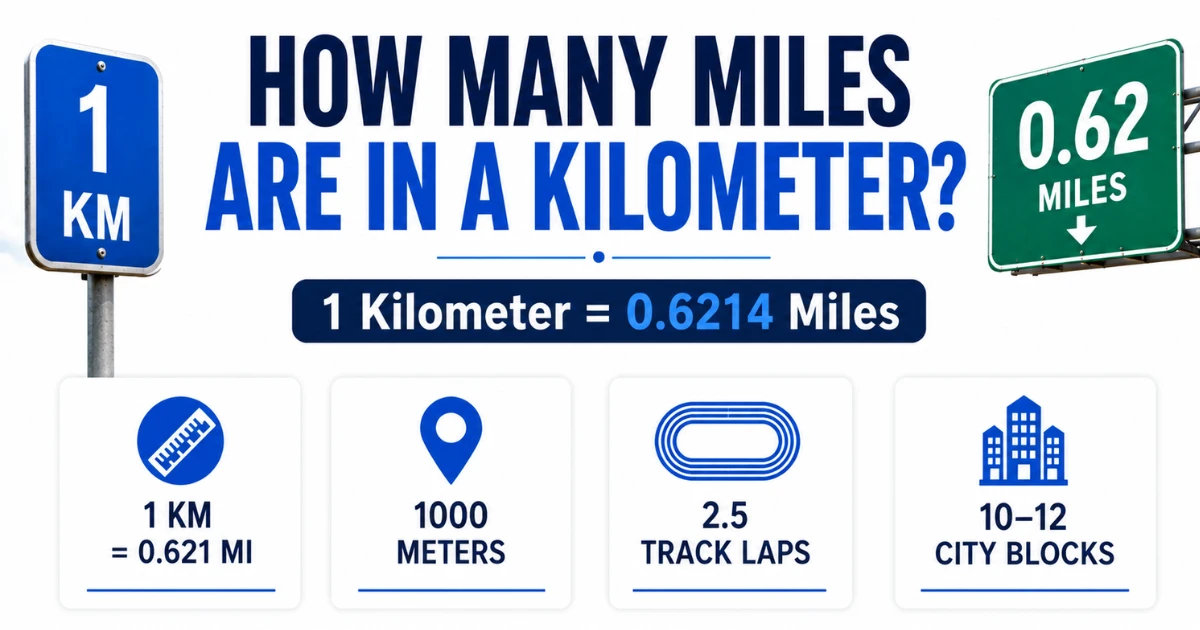
| 1 kilometer equals exactly 0.6214 miles — and that single number is all you need to confidently convert any distance on a GPS, road sign, or race registration form. . |
|---|
Most Americans know kilometers exist but can’t picture one. This guide fixes that — with the exact formula, a fast mental shortcut, a full conversion table, and five real-life U.S. examples that make 1 kilometer impossible to forget.
How Many Miles Are in a Kilometer
1 kilometer = 0.6214 miles.
That’s the clean, direct answer. One kilometer (km) is just over half a mile — specifically, about 62% of one mile.
The reverse is just as important: 1 mile = 1.609 kilometers. A mile is longer. Always.
Formula:
Miles = Kilometers × 0.6214
Mental Shortcut:
Multiply kilometers by 0.6 for a fast, close estimate. It’s not perfect, but for everyday use — reading a Canadian highway sign or pacing a 5K — it works immediately.
Worked Example:
8 km × 0.6214 = 4.97 miles (approximately 5 miles)
How Many Meters Are in a Kilometer
1 kilometer contains exactly 1,000 meters. No rounding. No approximation.
The prefix kilo- in the metric system always means one thousand. So 1 kilometer = 1,000 meters, 1 kilogram = 1,000 grams, and so on. The logic is universal.
| Kilometer | Meters |
|---|---|
| 1 km | 1000 m |
| 2 km | 2000 m |
| 3 km | 3000 m |
| 4 km | 4000 m |
| 5 km | 5000 m |
| 6 km | 6000 m |
| 7 km | 7000 m |
| 8 km | 8000 m |
| 9 km | 9000 m |
| 10 km | 10000 m |
| 11 km | 11000 m |
| 12 km | 12000 m |
| 13 km | 13000 m |
| 14 km | 14000 m |
| 15 km | 15000 m |
| 16 km | 16000 m |
| 17 km | 17000 m |
| 18 km | 18000 m |
| 19 km | 19000 m |
| 20 km | 20000 m |
| 21 km | 21000 m |
| 22 km | 22000 m |
| 23 km | 23000 m |
| 24 km | 24000 m |
| 25 km | 25000 m |
| 26 km | 26000 m |
| 27 km | 27000 m |
| 28 km | 28000 m |
| 29 km | 29000 m |
| 30 km | 30000 m |
| 31 km | 31000 m |
| 32 km | 32000 m |
| 33 km | 33000 m |
| 34 km | 34000 m |
| 35 km | 35000 m |
| 36 km | 36000 m |
| 37 km | 37000 m |
| 38 km | 38000 m |
| 39 km | 39000 m |
| 40 km | 40000 m |
| 41 km | 41000 m |
| 42 km | 42000 m |
| 43 km | 43000 m |
| 44 km | 44000 m |
| 45 km | 45000 m |
| 46 km | 46000 m |
| 47 km | 47000 m |
| 48 km | 48000 m |
| 49 km | 49000 m |
| 50 km | 50000 m |
How Many Miles in a Kilometer — Conversion Formula, Shortcut & Table
Here’s everything you need to convert kilometers to miles accurately and fast.
Exact Formula:
Miles = Kilometers × 0.6213712
Quick Mental Shortcut:
Multiply km × 0.6 for a fast estimate. For precision, use × 0.621.
Worked Example:
26.2 km (a marathon distance) × 0.6214 = 16.28 miles
| Kilometer | Miles |
|---|---|
| 1 km | 0.62 mi |
| 2 km | 1.24 mi |
| 3 km | 1.86 mi |
| 4 km | 2.49 mi |
| 5 km | 3.11 mi |
| 6 km | 3.73 mi |
| 7 km | 4.35 mi |
| 8 km | 4.97 mi |
| 9 km | 5.59 mi |
| 10 km | 6.21 mi |
| 11 km | 6.84 mi |
| 12 km | 7.46 mi |
| 13 km | 8.08 mi |
| 14 km | 8.70 mi |
| 15 km | 9.32 mi |
| 16 km | 9.94 mi |
| 17 km | 10.56 mi |
| 18 km | 11.18 mi |
| 19 km | 11.81 mi |
| 20 km | 12.43 mi |
| 21 km | 13.05 mi |
| 22 km | 13.67 mi |
| 23 km | 14.29 mi |
| 24 km | 14.91 mi |
| 25 km | 15.53 mi |
| 26 km | 16.16 mi |
| 27 km | 16.78 mi |
| 28 km | 17.40 mi |
| 29 km | 18.02 mi |
| 30 km | 18.64 mi |
| 31 km | 19.26 mi |
| 32 km | 19.88 mi |
| 33 km | 20.51 mi |
| 34 km | 21.13 mi |
| 35 km | 21.75 mi |
| 36 km | 22.37 mi |
| 37 km | 22.99 mi |
| 38 km | 23.61 mi |
| 39 km | 24.23 mi |
| 40 km | 24.85 mi |
| 41 km | 25.48 mi |
| 42 km | 26.10 mi |
| 43 km | 26.72 mi |
| 44 km | 27.34 mi |
| 45 km | 27.96 mi |
| 46 km | 28.58 mi |
| 47 km | 29.20 mi |
| 48 km | 29.83 mi |
| 49 km | 30.45 mi |
| 50 km | 31.07 mi |
Reverse Formula:
Kilometers = Miles × 1.60934
10 miles × 1.60934 = 16.09 km
How long is a kilometer ?
It’s about 10 to 12 standard American city blocks, a distance most people walk every day without thinking twice.
Here are five grounded U.S. examples that make how far a kilometer is permanently clear.
| CONVERSION | RULE / FORMULA | EXAMPLE |
|---|---|---|
| Kilometer → Miles | Multiply by 0.6214 | 8 km → 4.97 miles |
| Miles → Kilometer | Multiply by 1.60934 | 5 mi → 8.04 km |
| Kilometer → Meters | Multiply by 1000 | 5 km → 5000 m |
| Meters → Kilometer | Divide by 1000 | 5000 m → 5 km |
| Kilometer → Centimeters | Multiply by 100,000 | 1 km → 100000 cm |
| Centimeters → Kilometer | Divide by 100,000 | 100000 cm → 1 km |
| Kilometer → Millimeters | Multiply by 1,000,000 | 1 km → 1000000 mm |
| Millimeters → Kilometer | Divide by 1,000,000 | 1000000 mm → 1 km |
| 5K Formula | Multiply by 0.6214 | 5 km → 3.107 miles |
| Marathon Formula | 26.2 × 0.6214 | 16.28 miles |
| Walking Speed | 1 km ≈ 10–12 minutes | Normal walking pace |
| Running Pace | 1 km ≈ 5–6 minutes | Average running speed |
| Driving Speed | 1 km at 60 mph ≈ 37 sec | Highway travel |
| City Driving | 1 km at 30 mph ≈ 75 sec | City traffic speed |
5 Real-Life Examples That Make It Click
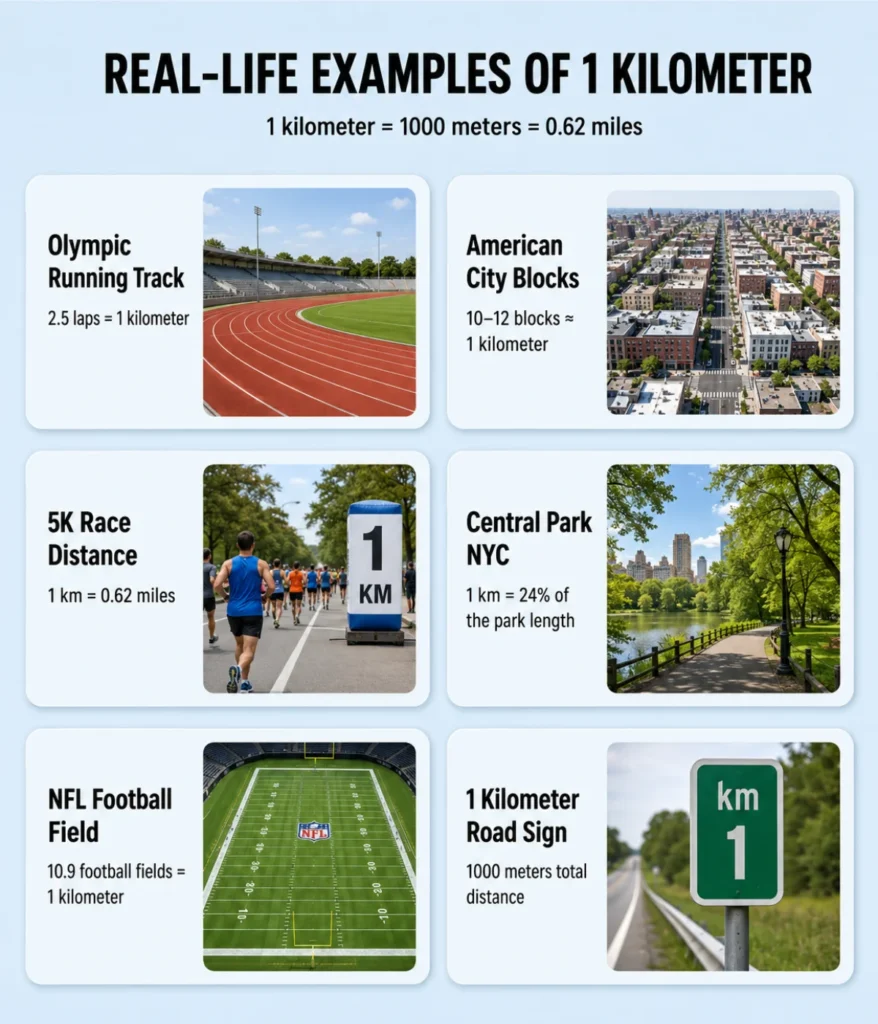
Standard Olympic Running Track — 400 Meters Per Lap
A certified outdoor Olympic track measures exactly 400 meters per lap.
To cover 1 full kilometer, you need exactly 2.5 laps.
Every U.S. high school and NCAA athletic facility uses this exact 400-meter standard — so next time you’re at a track, two and a half loops = one kilometer.
Standard American City Block — 80 to 100 Meters
According to the U.S. Department of Transportation urban planning guidelines, a standard U.S. city block averages 80 to 100 meters in length.
That makes 10 to 12 city blocks roughly equal to 1 kilometer. In Midtown Manhattan, walking from 42nd Street (Grand Central Terminal) to approximately 52nd Street covers almost exactly 1 kilometer.
The 5K Race — 3.107 Miles
The 5-kilometer race is the most popular road race distance in the United States, with over 8.9 million finishers annually according to Running USA’s annual report.
Five kilometers = 5 × 0.6214 = 3.107 miles. That means each individual kilometer in a 5K equals about 0.62 miles, or roughly 12 city blocks at a comfortable jogging pace.
Central Park, New York City — 4.1 Kilometers Long
Central Park stretches 4.1 kilometers from south (59th Street) to north (110th Street), according to the NYC Department of Parks & Recreation. One kilometer covers approximately 24% of the park’s full north-south length —
The American Heart Association recommends urban park walks as a primary cardiovascular activity target, and Central Park’s kilometer markers are a commonly referenced benchmark.
NFL Football Field — 91.44 Meters Long
A regulation NFL football field measures 100 yards (91.44 meters) from end zone to end zone, per NFL Official Rules. It takes approximately 10.9 football fields placed end to end to equal exactly 1 kilometer.
This comparison is widely used in U.S. science education to help students visualize metric distances in familiar American terms.
How Much Is a Kilometer in Your Daily Life — Walking, Driving & Running
This is what most people actually want to know — and what most blogs skip entirely.
How far is a kilometer isn’t just about numbers. It’s about time, effort, and real-world context.
Walking 1 Kilometer
The average American adult walks 1 kilometer in 10 to 12 minutes at a comfortable, moderate pace on flat terrain.
According to the American Council on Exercise (ACE), a typical walking speed is 3 to 4 mph (4.8 to 6.4 km/h), which puts 1 kilometer squarely in the 10–12 minute range for most people.
Running 1 Kilometer
- Casual jogger: 6 to 8 minutes per km
- Average recreational runner: 5 to 6 minutes per km
- Competitive runner: 3 to 4 minutes per km
The Boston Marathon average finishing pace is approximately 5 min/km for the top amateur field, according to Boston Athletic Association data.
Driving 1 Kilometer
At 60 mph (96.5 km/h), you cover 1 kilometer in approximately 37 seconds. At city speed limits of 30 mph (48 km/h), it takes about 75 seconds.
This is why GPS devices and navigation apps like Google Maps and Waze switch between miles and kilometers depending on the country setting — the distance itself doesn’t change, only the unit label does.
FAQ’s About How Many Miles Are in a Kilometer
How many miles are in a kilometer ?
1 kilometer equals 0.6214 miles — just over half a mile, using the formula: miles = km × 0.6214.
How many meters are in a kilometer ?
Exactly 1,000 meters make up 1 kilometer. The prefix kilo- always means one thousand in the metric system.
How many miles in a kilometer ?
1 km = 0.6214 miles. To quickly estimate, multiply kilometers by 0.6. For exact conversion, multiply by 0.6213712.
How long is a kilometer ?
At a normal walking pace, 1 kilometer takes about 10 to 12 minutes to cover on flat ground.
How far is a kilometer ?
1 kilometer equals roughly 10 to 12 standard American city blocks, or 2.5 laps around a standard 400-meter Olympic running track.
How much is a kilometer ?
1 kilometer is just over half a mile (0.6214 miles) — shorter than a full mile but longer than half a mile by about 214 meters.
Conclusion
1 kilometer = 0.6214 miles = 1,000 meters — and now you have five real-life U.S. examples that make that number impossible to forget.
Whether you’re reading a GPS device crossing into Canada, signing up for a 5K race, checking your Apple Watch, or teaching the metric system to a student, the shortcut is simple: multiply kilometers by 0.621 and you’re there.
The kilometer isn’t a foreign concept — it’s just a different lens on the same distance you walk every day.

Fitness guru and lead author, crafting every post with passion. Certified trainer dedicated to your online fitness journey—empowering steps toward a healthier you!