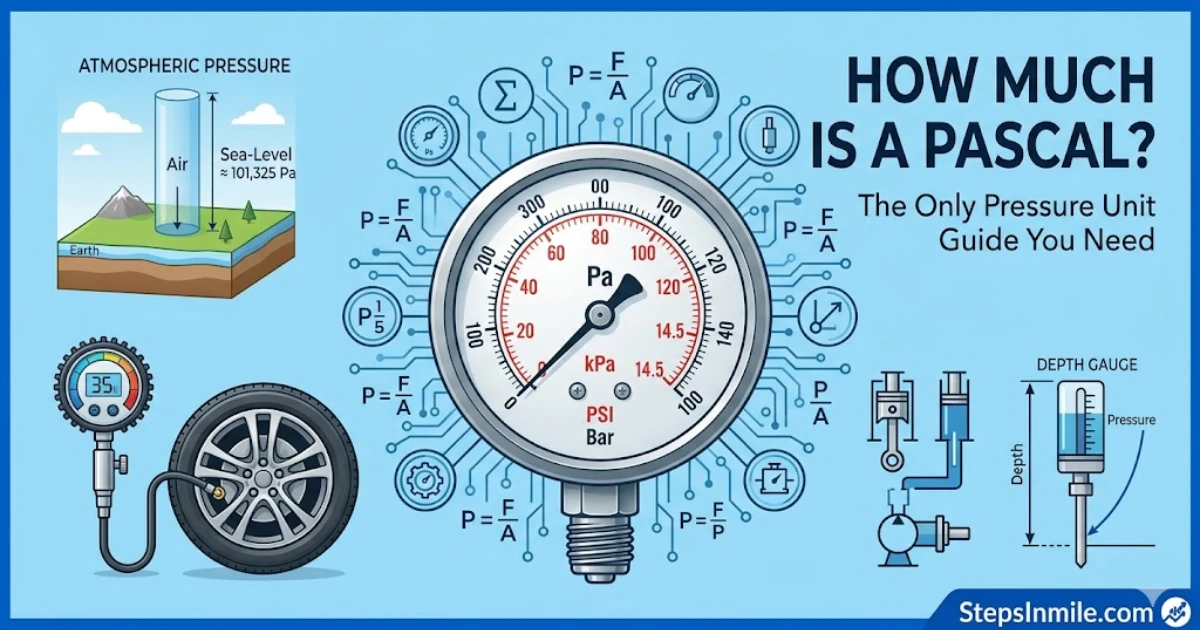
One pascal (Pa) equals exactly 1 Newton of force applied over 1 square meter of area — it is the official SI base unit of pressure recognized by the International System of Units (SI).
Most people have never heard of a pascal until they need to convert pressure readings for work, school, or a home project. This guide gives you every answer — from the exact value of 1 Pa to full conversions between PSI, bar, and pascal — fast, clear, and accurate.
What Is a Pascal and Exactly How Much Is It?
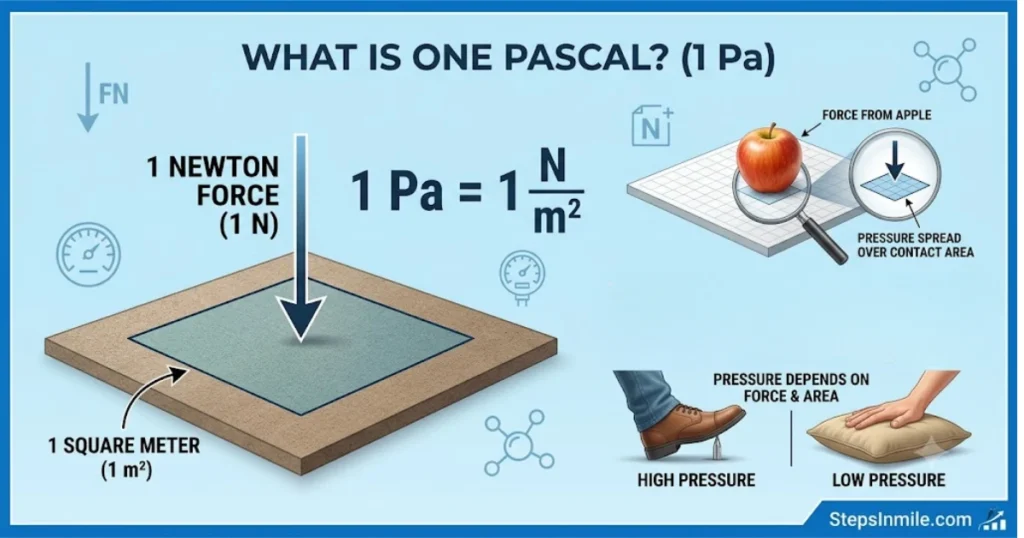
A pascal (Pa) is the SI unit of pressure. It was named after Blaise Pascal, the 17th-century French mathematician and physicist who laid the groundwork for fluid pressure mechanics.
The International Bureau of Weights and Measures (BIPM) formally defined the pascal as part of the SI unit system adopted in 1971.
The exact value:
1 Pascal = 1 Newton per square meter (N/m²)
To put that in plain terms — if you took a 1-kilogram apple and spread its entire weight evenly across 1 square meter of surface, the pressure it exerts is roughly 9.8 Pa. One pascal alone is tiny — barely more than the force of a single raindrop hitting a window.
That is exactly why pressure in everyday life — like tire pressure, blood pressure, or atmospheric pressure — is measured in kilopascals (kPa), megapascals (MPa), PSI, or bar, not in single pascals.
Key pascal scale facts:
- 1 kPa = 1,000 Pa
- 1 MPa = 1,000,000 Pa
- 1 standard atmosphere (atm) = 101,325 Pa
- 1 bar = 100,000 Pa
- 1 PSI = 6,894.76 Pa
The pascal is used across physics, engineering, meteorology, medicine, and construction as the universal language of pressure.
Pascal vs PSI vs Bar — Conversions, Formulas and Quick Shortcuts
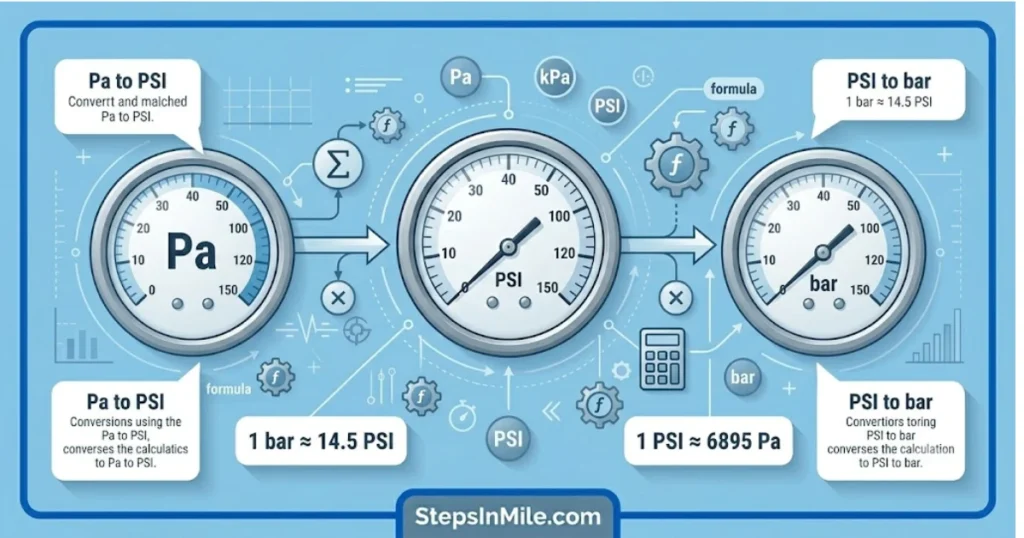
Understanding how much is a pascal compared to PSI and bar is where things get practically useful. These three units appear constantly across American engineering, HVAC systems, automotive specs, and industrial equipment.
Pascal to PSI Conversion
Formula:
Shortcut:
Divide pascals by 6,895 for a fast rounded answer.
Worked Example:
You have 50,000 Pa of pressure.
50,000 ÷ 6,894.76 = 7.25 PSI
Answer: 50,000 Pa is approximately 7.25 PSI.
That is roughly the pressure you feel in a lightly inflated bicycle tire.
PSI to Pascal Conversion
Formula:
Shortcut:
Multiply PSI by 6,895 for a quick estimate.
Worked Example:
Standard car tire pressure is 32 PSI.
32 × 6,894.76 = 220,632 Pa
220,632 Pa ÷ 1,000 = 220.6 kPa
Answer: 32 PSI is approximately 220,632 Pa or 220.6 kPa.
Pascal to Bar Conversion
Formula:
Shortcut:
Move the decimal point 5 places to the left.
Worked Example:
You have 250,000 Pa of pressure.
250,000 ÷ 100,000 = 2.5 bar
Answer: 250,000 Pa is equal to 2.5 bar.
That is a typical pressure for compressed air lines in industrial facilities.
Bar to Pascal Conversion
Formula:
Shortcut:
Move the decimal point 5 places to the right.
Worked Example:
You have 3.5 bar of pressure.
3.5 × 100,000 = 350,000 Pa
350,000 Pa ÷ 1,000 = 350 kPa
Answer: 3.5 bar is equal to 350,000 Pa or 350 kPa.
PSI to Bar Conversion
Formula:
Shortcut:
Multiply PSI by 0.069 for a quick estimate.
Worked Example:
You have 30 PSI of pressure.
30 × 0.0689476 = 2.07 bar
Answer: 30 PSI is approximately 2.07 bar.
Bar to PSI Conversion
Formula:
Shortcut:
Multiply bar by 14.5 for a quick estimate.
Worked Example:
You have 2 bar of pressure.
2 × 14.5038 = 29.01 PSI
Rounded to the nearest whole number = 29 PSI
Answer: 2 bar is approximately 29 PSI.
That is right in the range of a properly inflated passenger car tire by European automotive standards.
Quick Reference Conversion Summary:
- 1 Pa = 0.000145 PSI = 0.00001 bar
- 1 PSI = 6,894.76 Pa = 0.0689 bar
- 1 bar = 100,000 Pa = 14.504 PSI
- 1 atm = 101,325 Pa = 14.696 PSI = 1.01325 bar
These numbers are standardized by the National Institute of Standards and Technology (NIST) and the International Bureau of Weights and Measures (BIPM).
Real-Life Pascal Pressure Examples Every American Already Knows
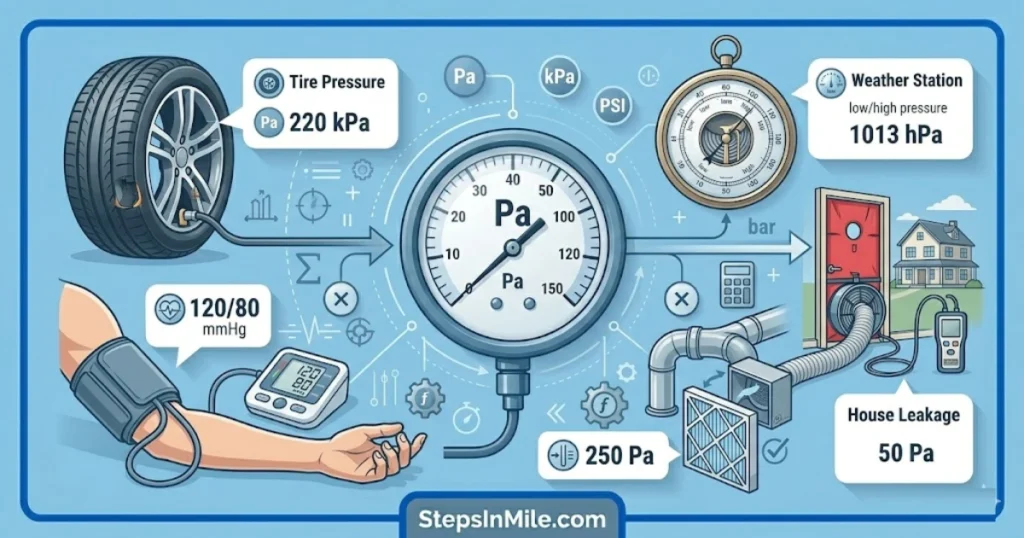
Abstract numbers mean nothing without real context. Here is where pascal pressure shows up in everyday American life.
Atmospheric Pressure
The standard atmospheric pressure at sea level is 101,325 Pa — also written as 101.3 kPa or approximately 14.7 PSI. The National Weather Service measures and reports this as barometric pressure, which shifts daily with weather systems.
Tire Pressure
Your car’s recommended tire inflation pressure is listed in PSI on the door jamb sticker. A standard sedan runs between 30–35 PSI, which translates to 206,843–241,317 Pa or roughly 2.07–2.41 bar. Under-inflation by even 5 PSI (~34,474 Pa) can reduce fuel economy by 0.2% per PSI according to the U.S. Department of Energy.
Blood Pressure
Blood pressure is measured in millimeters of mercury (mmHg) in the USA. A healthy reading of 120/80 mmHg equals approximately 15,998/10,666 Pa. The American Heart Association uses mmHg in clinical settings, but medical device manufacturers calibrate instruments in pascals for precision engineering.
HVAC and Air Duct Pressure
HVAC engineers in the USA measure duct static pressure in inches of water column (in. w.c.) or pascals. A standard residential duct system operates between 125–375 Pa (0.5–1.5 in. w.c.). The Sheet Metal and Air Conditioning Contractors’ National Association (SMACNA) sets duct pressure class ratings in pascals for commercial construction.
Building Envelope Testing
The blower door test — used by energy auditors and contractors across the USA — pressurizes a home to exactly 50 Pa to measure air leakage. This standard is set by ASTM International and the Air Barrier Association of America (ABAA). A tighter home at 50 Pa means lower heating and cooling costs year-round.
Weather and Meteorology
Meteorologists track pressure drops in hectopascals (hPa) — where 1 hPa = 100 Pa. A hurricane can drop surface pressure to below 920 hPa (92,000 Pa). The National Hurricane Center uses these readings to classify storm intensity.
How to Visualize One Pascal — A Practical Pressure Scale
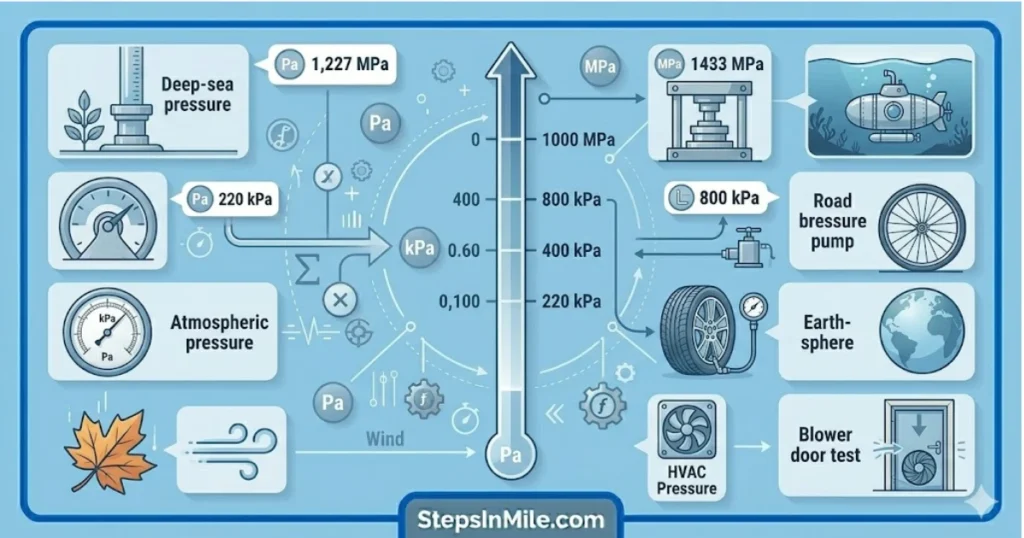
One pascal is genuinely tiny. Here is a pressure scale that puts it in perspective — from the smallest measurable pressures to the most extreme.
The Pascal Pressure Scale (Low to Extreme):
- ~1 Pa — Weight of a small leaf resting on 1 square meter of surface
- ~10 Pa — Lightest whisper of wind you can feel on your face
- ~25 Pa — Minimum building pressurization used in HVAC commissioning tests
- ~50 Pa — Standard U.S. blower door test pressure for home air sealing
- ~101,325 Pa (101.3 kPa) — Standard atmospheric pressure at sea level
- ~220,000 Pa (220 kPa / 32 PSI) — Typical car tire inflation
- ~690,000 Pa (690 kPa / 100 PSI) — Road bicycle tire pressure
- ~6,894,760 Pa (6.89 MPa / 1,000 PSI) — Light hydraulic press pressure
- ~100,000,000 Pa (100 MPa) — Deep-sea pressure at approximately 10,000 meters
The Dollar Bill Test
Here is the clearest mental model: Hold a single U.S. dollar bill flat. The air pressure pushing down on the top face of that bill at sea level is approximately 101,325 Pa. One pascal would be the pressure equivalent of 1/101,325th of that — barely measurable without precision instruments.
This is why pascal is the foundation unit, while kilopascal, megapascal, PSI, and bar are the practical working units for engineers, tradespeople, and scientists.
Instrument Types That Measure Pascal-Level Pressure:
- Manometers — Used in HVAC and building diagnostics; measures pressure in Pa and inches of water column (in. w.c.)
- Micromanometers — Ultra-sensitive instruments capable of resolving pressures below 1 Pa
- Barometers — Measures atmospheric pressure, typically displayed in hPa or Pa
- Pressure Transducers — Converts pressure in Pa into electrical signals for monitoring and automated control systems
- Pitot Tubes — Measures fluid flow velocity using pascal-scale dynamic pressure
These instruments are used daily by HVAC technicians, energy auditors, structural engineers, and weather stations across the United States.
FAQ’s About Pascal, PSI, and Bar
How many PSI in a bar?
1 bar = 14.5038 PSI. Bar is a metric unit used widely in European automotive and industrial specs. PSI (pounds per square inch) is the standard in the USA for tire pressure, hydraulics, and fluid systems.
How many bar in a PSI?
1 PSI = 0.0689476 bar. To convert PSI to bar quickly, multiply your PSI value by 0.069.
How many pascals in a bar?
1 bar = 100,000 pascals (Pa), which is also written as 100 kPa. Bar is exactly 100,000 times larger than one pascal by definition.
How many pascals in a PSI?
1 PSI = 6,894.76 pascals. For quick math, use 6,895 Pa per PSI. This conversion is standardized by NIST (National Institute of Standards and Technology).
How much is a PSI?
1 PSI is the pressure of 1 pound of force applied to 1 square inch of area. It is the dominant pressure unit in everyday American use — from tire gauges to water heaters to pneumatic tools.
How much is a bar?
1 bar is approximately equal to the atmospheric pressure at sea level — specifically 0.987 atm. It equals 100,000 Pa or 14.5038 PSI. It is widely used in European automotive, industrial, and diving pressure standards.
How much is a pascal?
1 pascal equals 1 Newton of force per square meter of area (1 N/m²). It is extremely small — roughly the pressure exerted by a thin piece of paper lying flat on a table. It is the SI base unit of pressure defined by the International Bureau of Weights and Measures.
Conclusion
One pascal is small in value but massive in importance. It is the foundation of every pressure measurement used in science, medicine, construction, aviation, and industry across the United States and the world.
Now you know exactly how much is a pascal, how to convert it to PSI and bar using fast formulas, where it shows up in your daily life — and why the professionals who rely on it take it seriously.
.

Fitness guru and lead author, crafting every post with passion. Certified trainer dedicated to your online fitness journey—empowering steps toward a healthier you!