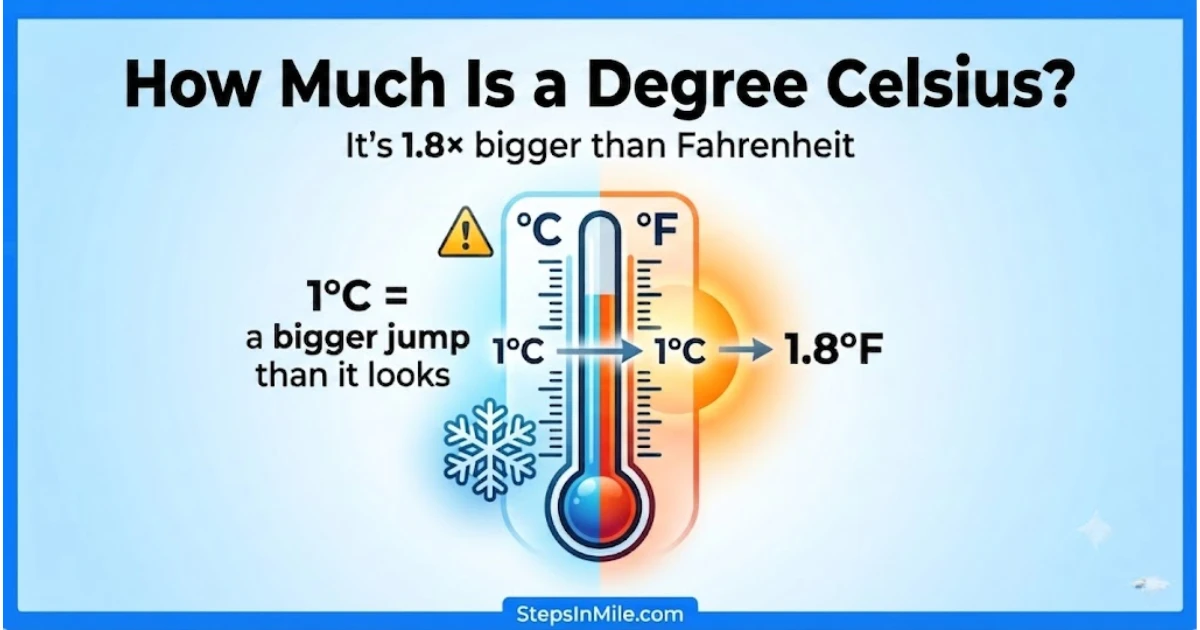
One degree Celsius equals 1.8 degrees Fahrenheit — making it nearly double the size of a single Fahrenheit degree.
This guide breaks down exactly how much is a degree Celsius, how to convert it fast, and how to feel it — not just calculate it.
What Exactly Is a Degree Celsius — And What Does One Degree Actually Represent?
A degree Celsius (°C) is a unit of temperature measurement defined by the International System of Units (SI). It is the standard unit of temperature used in science, medicine, and everyday life in nearly every country on Earth — except the United States, which primarily uses Fahrenheit (°F).
The Celsius scale was developed by Swedish astronomer Anders Celsius in 1742. He anchored it around two fixed points of water:
0°C = the freezing point of water
100°C = the boiling point of water
That gives the scale exactly 100 equal steps between those two points. This is why it was originally called centigrade — meaning “100 steps.” The name was officially changed to Celsius in 1948 by the General Conference on Weights and Measures (CGPM).
Now here’s what most people don’t fully grasp:
One degree Celsius represents 1/100th of the range between water’s freezing and boiling points. That’s a precisely defined, meaningful unit — not an arbitrary one.
On the Fahrenheit scale, that same range spans 180 degrees (from 32°F to 212°F). So the Celsius scale compresses more thermal change into fewer degrees. That makes every single Celsius degree carry more weight than a Fahrenheit degree.
How to Convert Celsius to Fahrenheit — The Exact Formula, Mental Shortcut & Quick Reference Chart
The Exact Formula
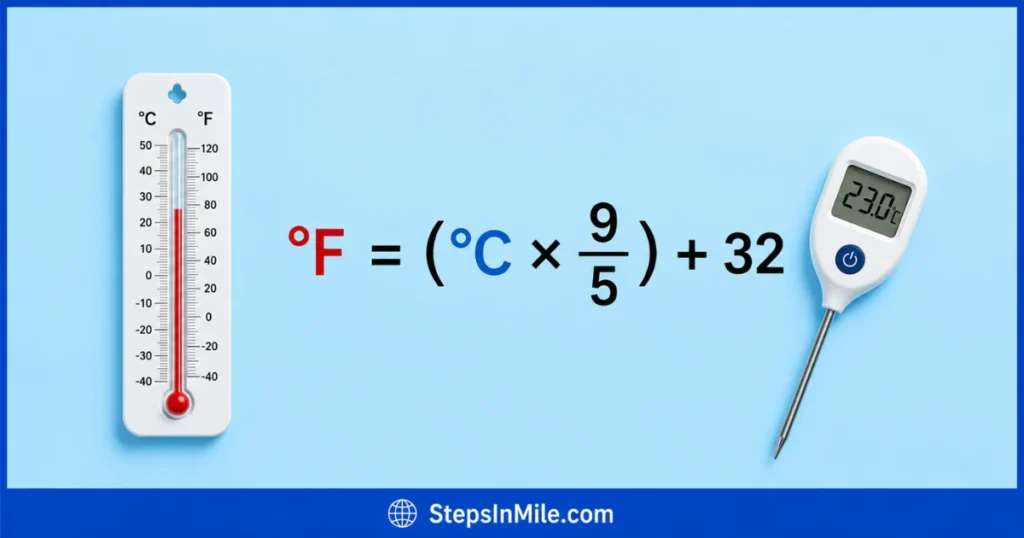
The official temperature conversion formula is:
°F = (°C × 9/5) + 32
Or written another way:
°F = (°C × 1.8) + 32
Worked Example
Convert 25°C to Fahrenheit:
- Step 1: 25 × 1.8 = 45
- Step 2: 45 + 32 = 77°F
So 25°C = 77°F — a warm, comfortable day.
The Mental Shortcut (No Calculator Needed)
When you need a fast estimate, use this shortcut:
Double the Celsius number, then subtract 10, then add 32.
Example: 20°C
- Double: 20 × 2 = 40
- Subtract 10: 40 − 10 = 30
- Add 32: 30 + 32 = 62°F (exact answer: 68°F — close enough for everyday use)
For precision, always use the full formula. For a quick gut check, the shortcut works fine.
Quick Celsius to Fahrenheit Reference
| Celsius (°C) | Fahrenheit (°F) | What It Means |
| −40°C | −40°F | The point where both scales meet |
| 0°C | 32°F | Freezing point of water |
| 20°C | 68°F | Comfortable room temperature |
| 37°C | 98.6°F | Normal human body temperature |
| 100°C | 212°F | Boiling point of water |
Why One Celsius Degree Feels Bigger Than One Fahrenheit Degree —
Here’s the fact that almost no basic blog explains clearly:
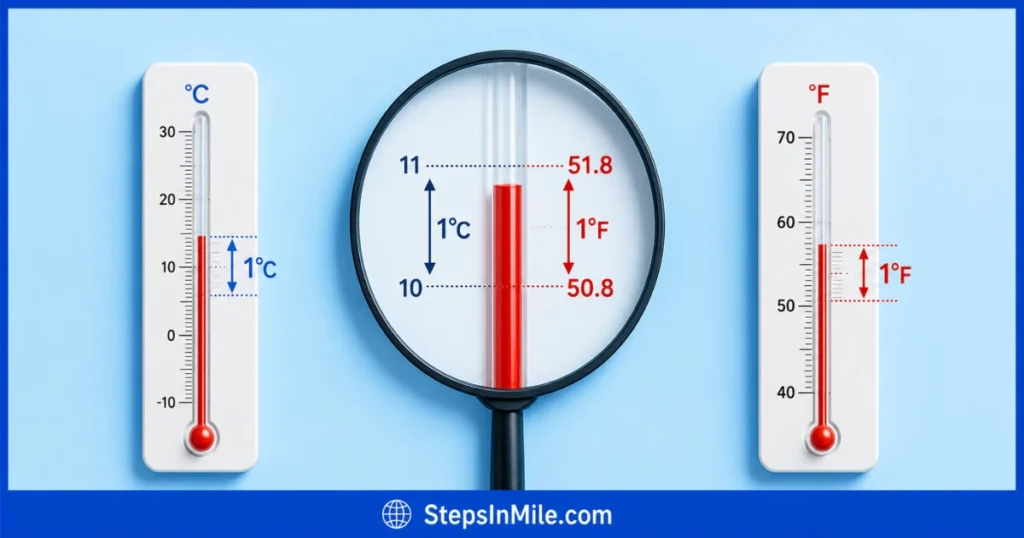
1°C = 1.8°F
That means a change of one single Celsius degree is equivalent to a change of 1.8 Fahrenheit degrees. In other words, one Celsius degree is 80% larger than one Fahrenheit degree.
This is not a technicality. It has real, everyday consequences:
In medicine: A fever that rises by 1°C (from 37°C to 38°C) feels like a jump of 1.8°F to your body. That’s significant. It’s why doctors worldwide prefer Celsius for clinical precision — smaller numbers, bigger meaning.
In climate science: When scientists say global temperatures have risen by 1.1°C since pre-industrial times, that’s not a small change. In Fahrenheit terms, that’s already nearly 2°F of warming. The Celsius number sounds smaller, but it represents serious thermal shift.
In cooking: The difference between 180°C and 190°C in an oven is 18°F. That 10-degree Celsius gap can mean the difference between a perfectly baked cake and an overbaked one.
The core answer to “how much is a degree Celsius”: One degree Celsius equals 1.8 Fahrenheit degrees in size. It is a larger, more thermally significant unit than a degree Fahrenheit.
This is the precise, physics-based answer — and it’s what competitors consistently fail to explain.
The Fastest Way to Visualize Celsius in Your Head Without a Calculator
Most Americans don’t need to calculate Celsius perfectly. They need to feel it instantly. Here’s how.
The 3-Anchor Method
Lock in just three reference points, and you can estimate any Celsius temperature by feel:
0°C → Freezing. Ice. Snow. Bundle up.
30°C → Hot summer day. Shorts and sunscreen.
100°C → Boiling water. Steam. Dangerous heat.
Everything else falls in between. Once these three numbers are anchored in your mind, Celsius starts to feel intuitive — not foreign.
Body-Based Anchors
Your own body is a built-in thermometer:
Real-Life Celsius Temperature Examples
Below 10°C → Your breath is visible. You feel cold fast.
20–22°C → Most Americans feel perfectly comfortable indoors.
37°C → That’s you. Your internal temperature. Your baseline.
Above 40°C → Heat that harms. Dangerous for outdoor activity.
The “Is It Hot or Cold?” Rule
A quick rule that works for weather:
Celsius below 15°C → You’ll want a coat.
Celsius around 20°C → Comfortable.
Celsius above 30°C → It’s hot. Stay hydrated.
Use this framework every time you read a Celsius number, and within weeks, it becomes second nature. No conversion needed.
FAQ’s about How Much Is 1 Degree Celsius
How to Convert Celsius to Fahrenheit?
Use the formula: °F = (°C × 1.8) + 32. Multiply the Celsius value by 1.8, then add 32. For example, 20°C × 1.8 = 36 + 32 = 68°F.
What Is 0 Celsius in Fahrenheit?
0°C = 32°F. This is the freezing point of water — the temperature at which liquid water turns to ice at standard atmospheric pressure.
What Is 100 Celsius in Fahrenheit?
100°C = 212°F. This is the boiling point of water at sea level. Both scales define this as their upper reference point.
How Much Is a Degree Celsius?
One degree Celsius equals 1.8 degrees Fahrenheit. It is a larger unit than a Fahrenheit degree, meaning a single Celsius step represents a bigger temperature change than a single Fahrenheit step.
Conclusion
A degree Celsius is not just a foreign unit — it’s a more precise, more meaningful unit of temperature.One °C equals 1.8°F, the Celsius scale runs from the freezing point of water (0°C) to the boiling point (100°C), and it is the global standard in science, medicine, and international weather.
Once you know the formula — °F = (°C × 1.8) + 32 — and lock in three anchors (0, 30, 100), Celsius stops being confusing and starts making perfect sense.

Fitness guru and lead author, crafting every post with passion. Certified trainer dedicated to your online fitness journey—empowering steps toward a healthier you!