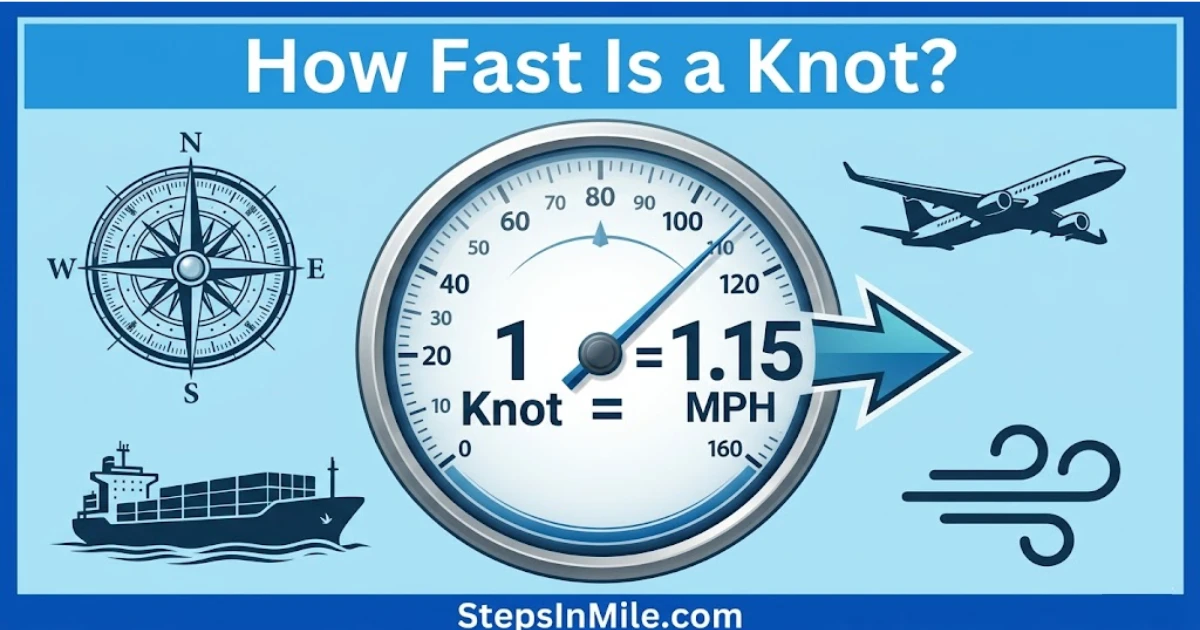
1 knot = 1.15078 miles per hour (mph) = 1.852 kilometers per hour (km/h) = 1.68781 feet per second (ft/s).
If you’ve ever watched a weather forecast, boarded a cruise ship, or tracked a flight, you’ve encountered knots. But what does that number actually mean in terms you feel every day? This guide breaks it down — completely, clearly, and with zero guesswork.
Knots to MPH, KM/H & Feet Per Second Reference Chart
| Knots | MPH | KM/H | Feet/Second |
|---|---|---|---|
| 1 | 1.15 | 1.85 | 1.69 |
| 5 | 5.75 | 9.26 | 8.44 |
| 10 | 11.51 | 18.52 | 16.88 |
| 15 | 17.26 | 27.78 | 25.32 |
| 20 | 23.02 | 37.04 | 33.76 |
| 25 | 28.77 | 46.30 | 42.20 |
| 30 | 34.52 | 55.56 | 50.63 |
| 40 | 46.03 | 74.08 | 67.51 |
| 50 | 57.54 | 92.60 | 84.39 |
| 60 | 69.05 | 111.12 | 101.27 |
| 100 | 115.08 | 185.20 | 168.78 |
How Fast Is a Knot
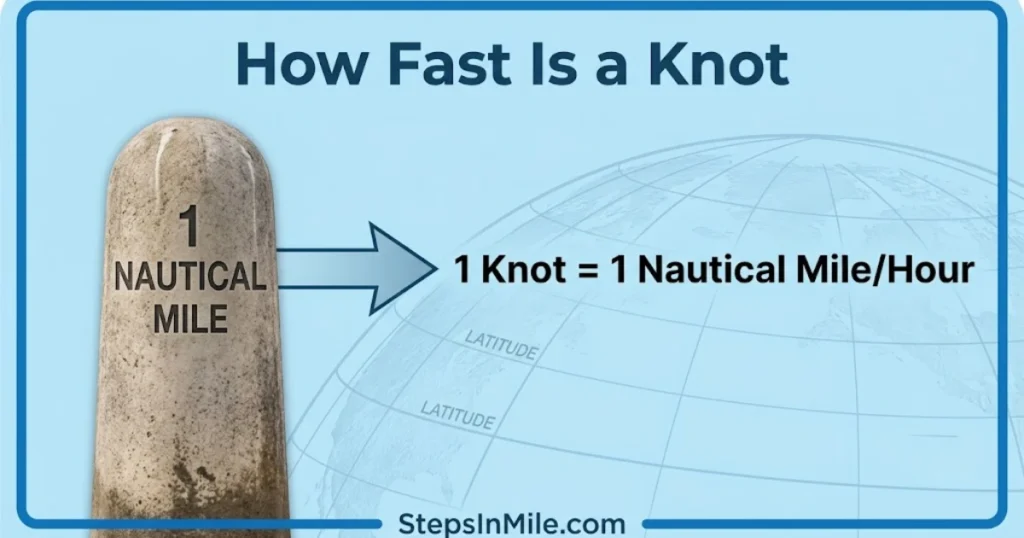
A knot is exactly 1 nautical mile per hour.
That single sentence is the foundation of everything. But to truly understand how fast a knot is, you first need to understand what a nautical mile actually is — because it’s not the same as a regular mile.
A nautical mile equals 1,852 meters, or about 6,076 feet. By comparison, a standard land mile (statute mile) is only 5,280 feet. That gap of nearly 800 feet is why 1 knot is slightly faster than 1 mph — not by much, but enough to matter in precision navigation.
So, how fast is a knot compared to mph?
- 1 knot = 1.15078 mph
- 1 knot = 1.852 km/h
- 1 knot = 1.68781 feet per second
And going the other direction:
- 1 mph = 0.868976 knots
- 1 km/h = 0.539957 knots
Now you have the baseline. Everything below builds on it.
Knots to MPH, KPH & Feet Per Second — Formula, Table & Mental Shortcut
This is where numbers become tools. Below are the exact conversion formulas, a quick reference table, and a mental shortcut so you never need a calculator again.
Knots to MPH Conversion Formula & Quick Reference Table
How to Convert Knots to MPH
Formula:
Worked Example:
You have a speed of 20 knots.
20 × 1.15078 = 23.02 mph
Answer: 20 knots is equal to 23.02 mph.
How to Convert MPH to Knots
Formula (Reverse):
Worked Example:
You have a speed of 60 mph.
60 × 0.868976 = 52.14 knots
Answer: 60 mph is equal to 52.14 knots.
Knots to MPH, KM/H & Feet Per Second
How to Convert Knots to KM/H
Knots to KM/H Formula:
Worked Example:
You have a speed of 30 knots.
30 × 1.852 = 55.56 km/h
Answer: 30 knots is equal to 55.56 km/h.
How to Convert KM/H to Knots
KM/H to Knots Formula:
Worked Example:
You have a speed of 100 km/h.
100 × 0.539957 = 53.99 knots
Answer: 100 km/h is equal to 53.99 knots.
How to Convert MPH to KM/H
MPH to KM/H Formula:
Worked Example:
You have a speed of 60 mph.
60 × 1.60934 = 96.56 km/h
Answer: 60 mph is equal to 96.56 km/h.
How to Convert MPH to Feet Per Second
Feet Per Second from MPH Formula:
Worked Example:
You have a speed of 30 mph.
30 × 1.46667 = 44 feet per second
Answer: 30 mph is equal to 44 feet per second.
The Easiest Mental Math Shortcut for Knots to MPH
You don’t always have a calculator on a dock, a cockpit, or a weather deck. Here is the single most useful shortcut for USA readers:
Quick Mental Shortcut: Knots to MPH
To estimate knots to mph in your head, add approximately 15% to the knot value.
- 20 knots → 20 + 3 (15% of 20) = ~23 mph ✓
- 40 knots → 40 + 6 = ~46 mph ✓
- 60 knots → 60 + 9 = ~69 mph ✓
This works because 1 knot = 1.15078 mph — the 15% rule captures that relationship instantly. Pilots, sailors, and NOAA meteorologists use this mental trick constantly. Now you can too.
How Fast Is a Knot in Real Life? Ships, Aircraft, Wind & Weather
Numbers on paper are one thing. Real-world scale is another. Here is exactly how fast a knot is when applied to the vessels, aircraft, and weather systems that use it every day.
How Fast Do Boats, Planes & Storms Move in Knots vs. MPH?
Boats, airplanes, and weather systems often use knots to measure speed instead of miles per hour (mph). Since 1 knot = 1.15 mph, a speed of 20 knots is about 23 mph, while 60 knots is about 69 mph.
Vessels at Sea
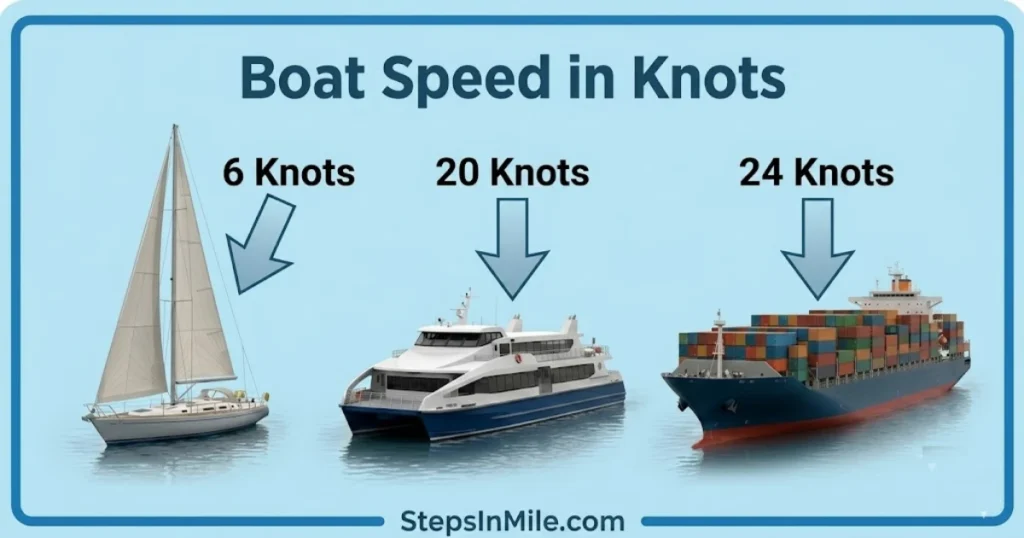
- Average sailboat — 5–7 knots (~5.75–8 mph). Enough to feel the wind, not enough to race.
- Passenger ferry — 12–20 knots (~14–23 mph). Steady, efficient, and fuel-conscious.
- Cargo ship / container vessel — 20–24 knots (~23–27 mph). This is the backbone of global trade and maritime commerce.
- U.S. Navy destroyer (DDG-51 Arleigh Burke class) — 30+ knots (~35+ mph). Built for speed and combat agility across open ocean.
- Fastest conventional vessel ever recorded — The Spirit of Australia set a water speed record of 317.6 km/h, equivalent to roughly 171 knots in 1978, according to the World Speed Record archives.
Aircraft in the Sky
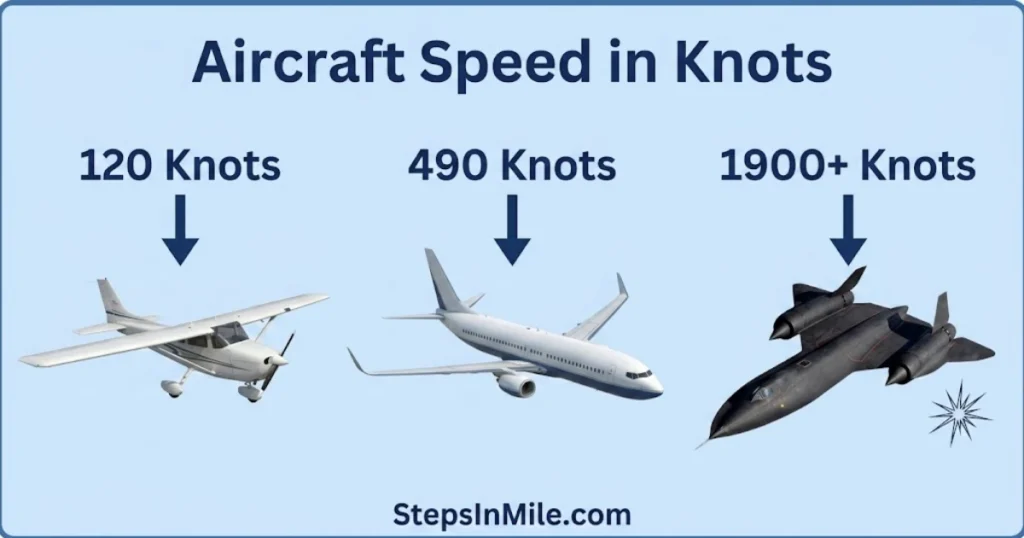
- Small Cessna 172 (general aviation) — ~120 knots (~138 mph). A staple of FAA-certified flight training across the United States.
- Boeing 737 (commercial jet) — ~450–490 knots (~518–564 mph) at cruise altitude.
- Boeing 747 — ~490–500 knots (~564–575 mph) at 35,000 feet.
- Lockheed SR-71 Blackbird (U.S. reconnaissance aircraft) — over 1,900 knots (~2,200 mph), placing it well above Mach 3.
Wind & Weather Systems
- Beaufort Scale Force 6 (Strong Breeze) — 22–27 knots (~25–31 mph). Creates large waves and is challenging for small craft.
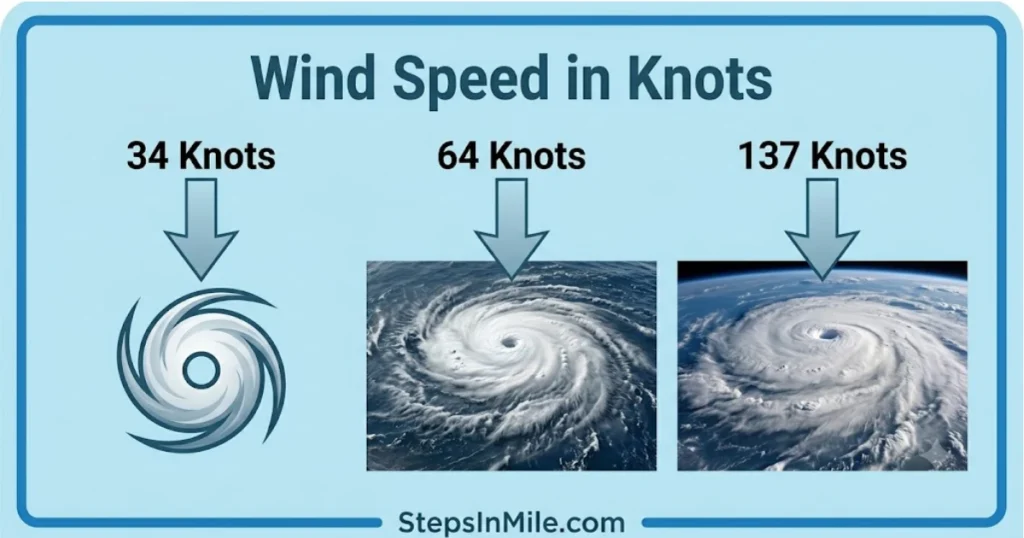
- Tropical Storm threshold — 34 knots (39 mph). This is the official dividing line between a tropical depression and a tropical storm, per the National Hurricane Center (NHC).
- Category 1 Hurricane — begins at 64 knots (74 mph). Capable of causing dangerous storm surge and structural damage.
- Category 5 Hurricane — 137 knots (157 mph) or higher. The most destructive classification on the Saffir-Simpson Hurricane Wind Scale.
- Record surface wind gust — 253 km/h (136.6 knots) recorded at Barrow Island, Australia during Cyclone Olivia in 1996, according to the World Meteorological Organization (WMO).
How to Instantly Picture Knot Speed — A Visual Guide for Non-Sailors
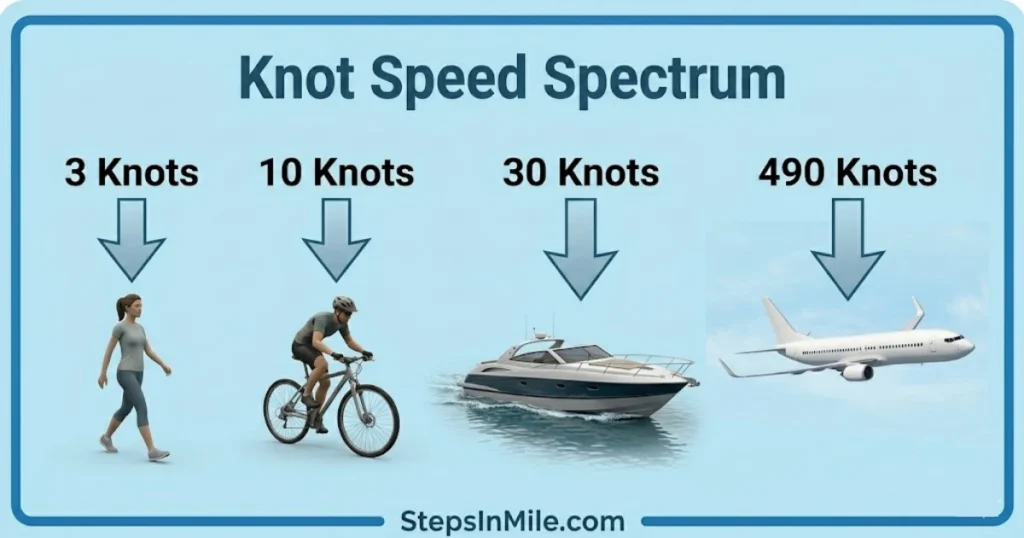
The Knot Speed Spectrum:
- 1 knot (1.15 mph) → Slower than a casual walk (average human walking pace is about 3 mph). Imagine a slow shuffle down a grocery store aisle.
- 3 knots (3.45 mph) → About the pace of a brisk walk on a sidewalk.
- 6 knots (6.9 mph) → A light jogging pace. A fit person’s easy run.
- 10 knots (11.5 mph) → A bicycle cruising on a flat road. City bike-lane speed.
- 20 knots (23 mph) → Surface streets in a U.S. suburb. A school zone speed limit doubled.
- 30 knots (34.5 mph) → A rural highway or a fast-moving motorboat.
- 60 knots (69 mph) → Interstate highway driving. The pace of a Category 1 hurricane wind.
- 120 knots (138 mph) → A Cessna taking off. Faster than any legal road speed in the U.S.
- 490 knots (564 mph) → A commercial Boeing 737 at cruise altitude, 35,000 feet above the ground.
- 900 knots (1,036 mph) → Above the speed of sound (Mach 1). Fighter jet territory.
FAQ’s About Knots
How Many Feet Per Second in a Mile Per Hour?
1 mph = 1.46667 feet per second. To convert, multiply your mph value by 1.46667. At 60 mph, you’re covering 88 feet every second — roughly the length of a standard American school bus every second.
How Many Kilometers Per Hour in a Mile Per Hour?
1 mph = 1.60934 km/h. Multiply any mph figure by 1.60934 to get km/h. The U.S. highway speed of 65 mph equals approximately 104.6 km/h.
How Many Miles Per Hour in a Kilometer Per Hour?
1 km/h = 0.621371 mph. Multiply km/h by 0.621 to convert to mph. A speed of 100 km/h — common on European roads — equals roughly 62.1 mph.
How Many Knots in a Mile Per Hour?
1 mph = 0.868976 knots. To convert mph to knots, multiply by 0.869. A car traveling at 70 mph is moving at approximately 60.8 knots.
How Many Miles Per Hour in a Knot?
1 knot = 1.15078 mph. Multiply any knot value by 1.15 to get a close mph equivalent. A 20-knot wind is approximately 23 mph — enough to make sailing lively and flags snap hard.
How Fast Is a Mile Per Hour?
1 mph is the speed of a very slow walk — about 88 feet per minute or 1.47 feet per second. At 1 mph, it would take you exactly 60 minutes to walk one statute mile (5,280 feet).
How Fast Is a Knot?
1 knot = 1.15078 mph = 1.852 km/h = 1.68781 feet per second. It is slightly faster than 1 mph because a nautical mile (6,076 feet) is longer than a statute mile (5,280 feet). One knot is the pace of a slow shuffle — but stack 500 of them and you’re flying a commercial jet across the continent.
Conclusion
A knot is 1.15 mph, 1.852 km/h, and 1.688 feet per second — and it is the backbone of how speed is measured across every ocean, sky, and storm system on Earth, including across the United States.
It is not an old-fashioned unit holding on out of stubbornness. It is a precision navigational tool locked to the geometry of the Earth, trusted by the U.S. Navy, the FAA, NOAA, and every air traffic controller from New York to Los Angeles.

Fitness guru and lead author, crafting every post with passion. Certified trainer dedicated to your online fitness journey—empowering steps toward a healthier you!