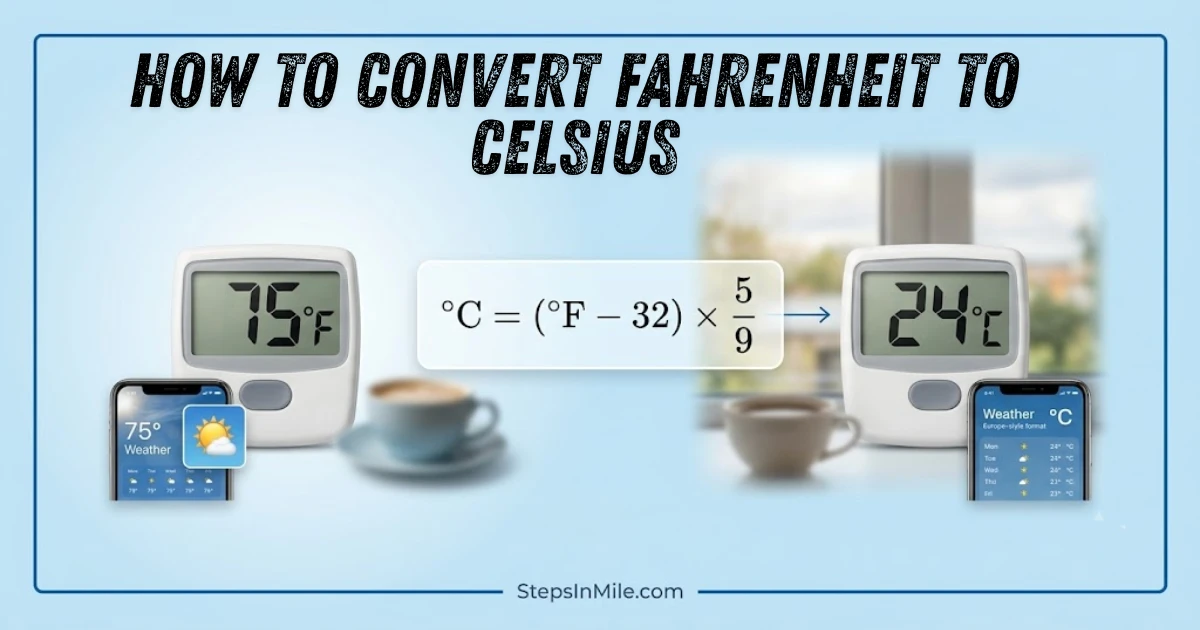
Whether you’re reading a US weather forecast, checking a fever temperature, or following a recipe from Europe, knowing how to switch between °F and °C is a practical life skill.
What Is the Fahrenheit to Celsius Formula (And How Does It Actually Work)?
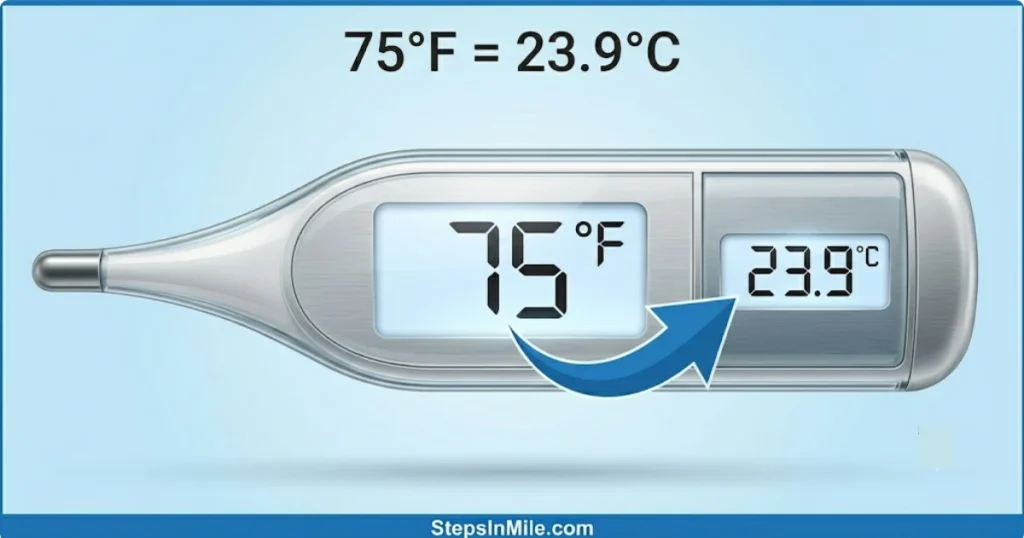
The Fahrenheit to Celsius conversion formula is:
That’s it. Three steps — subtract, multiply, divide. Let’s break it down so it actually makes sense.
The Fahrenheit to Celsius formula subtracts 32°F first because it aligns the shared freezing point of water (32°F = 0°C), then multiplies by 5/9 to adjust for the different degree sizes between the two scales.
Celsius is the global SI temperature standard used in science and medicine, while Fahrenheit remains the primary temperature measurement system in the United States.
Worked Example — Converting 75°F to Celsius:
Step 2: 43 × 5 = 215
Step 3: 215 ÷ 9 = 23.9°C
So 75°F = 23.9°C — a warm, comfortable spring day.
The Exact Formula vs. The Easy Shortcut: Which Should You Use?
When you don’t have a calculator, use this mental math shortcut:
It’s not perfectly precise, but it’s fast and close enough for everyday use.
Example using the shortcut for 80°F:
50 ÷ 2 = 25°C
The exact answer is 26.7°C — the shortcut gets you within 1–2 degrees. That’s more than good enough when you’re checking the outdoor temperature or reading a weather app.
Use the exact formula when precision matters — medical temperatures, baking, laboratory work, or scientific calculations.
Use the shortcut for quick, everyday estimates — weather, travel, casual conversation.
Fahrenheit to Celsius Conversion Chart: Common Temperatures at a Glance
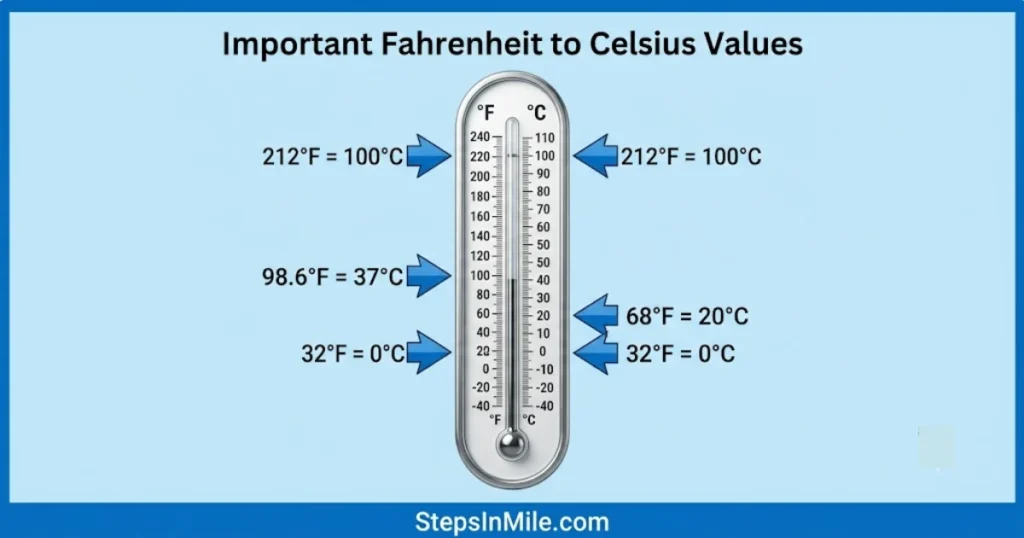
Here are the most searched °F to °C reference values — all calculated using the exact formula:
| Fahrenheit (°F) | Celsius (°C) | What It Represents |
|---|---|---|
| −40°F | −40°C | The crossover point — both scales are equal |
| 0°F | −17.8°C | Extreme winter cold |
| 32°F | 0°C | Freezing point of water |
| 50°F | 10°C | Cool, jacket weather |
| 68°F | 20°C | Room temperature |
| 72°F | 22.2°C | Ideal indoor comfort zone |
| 98.6°F | 37°C | Normal human body temperature |
| 100°F | 37.78°C | Slight fever threshold |
| 104°F | 40°C | High fever — medical attention advised |
| 212°F | 100°C | Boiling point of water |
| 350°F | 176.7°C | Standard baking oven temperature |
| 451°F | 232.8°C | Ignition point of paper (per Fahrenheit 451) |
32°F = 0°C, the freezing point of water, making it one of the most important reference values for temperature conversion between Fahrenheit and Celsius.
100°F = 37.78°C, slightly above normal body temperature (37°C), which is why it is commonly associated with a low-grade fever in the United States.
Real-Life Examples: Converting Fahrenheit to Celsius in Everyday Situations
Temperature conversion isn’t just a math exercise. It shows up in real life constantly — especially in the United States, where °F is standard but global content, products, and people use °C.
1. Checking the Weather
You open a US weather app and it reads 95°F. A friend from Germany asks what the temperature is. You need °C.
That’s a hot summer day — your friend immediately understands.
2. Reading a Fever Thermometer
Your child’s digital thermometer reads 101°F. The pediatrician uses Celsius for clinical records.
According to the American Academy of Pediatrics (AAP), a fever in children is defined as a rectal temperature of 38°C (100.4°F) or higher. At 38.3°C, this warrants monitoring.
3. Following a European Baking Recipe
A French recipe calls for an oven temperature of 180°C. Your US oven shows °F.
You’d set your oven to approximately 350°F — the standard moderate baking temperature.
4. Setting a Thermostat
Most American smart thermostats (like Nest or Ecobee) display °F. The recommended indoor comfort zone per the U.S. Department of Energy is 68–72°F in winter, which equals roughly 20–22°C.
5. Understanding International News
A heatwave in Spain hits 42°C. US news reports the same heatwave in °F.
Now you feel the severity instantly.
The One Thing Most Conversion Guides Never Tell You (The −40 Rule & Body Anchor Trick)
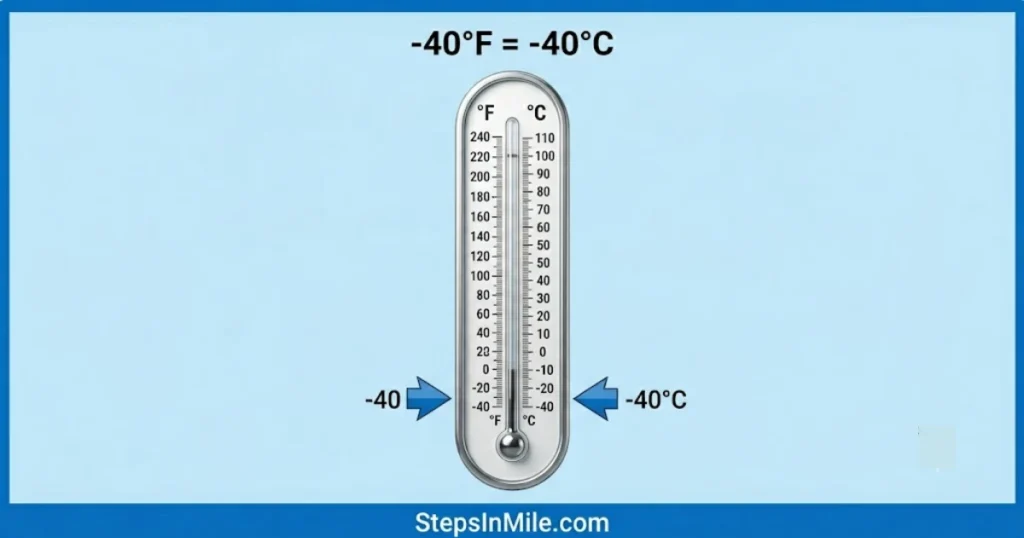
The −40° Crossover Rule
At exactly −40 degrees, Fahrenheit and Celsius are identical. The formula proves it:
This isn’t just trivia. It’s a powerful mental anchor. If you ever remember this single fact, you can estimate any other conversion by counting up or down from −40.
The Body Temperature Anchor
98.6°F = 37°C — the normal human core body temperature, established by German physician Carl Wunderlich in 1851. This is the most memorable reference point for temperature conversion.
Once you know this, your mental math becomes easier:
Cooler than 68°F? You’re below 20°C — time for a jacket.
The “Body-to-Boiling” Mental Scale
Think of temperature in three anchors:
Body → 98.6°F = 37°C
Boiling → 212°F = 100°C
Everything else slots between these. You now have a mental temperature number line — no app needed.
Why Fahrenheit and Celsius Were Different in the First Place
Fahrenheit (1724) and Celsius (1742) were created using different temperature measurement reference points, with Celsius based on water’s freezing and boiling points, making it the global scientific standard.
Today, Celsius is the most widely used temperature scale, while the United States, along with Myanmar and Liberia, still primarily uses Fahrenheit for everyday measurements.
FAQ’s about Fahrenheit to Celsius
How to convert Fahrenheit to Celsius?
Subtract 32 from the Fahrenheit temperature, then multiply by 5/9. Formula: °C = (°F − 32) × 5/9. For a quick estimate, use: °C ≈ (°F − 30) ÷ 2.
What is 32 Fahrenheit in Celsius?
32°F = 0°C. This is the freezing point of water on both the Fahrenheit and Celsius scales. It is one of the most important reference points in temperature measurement.
What is 100 Fahrenheit in Celsius?
100°F = 37.78°C. This is just above normal body temperature (37°C) and is commonly used in the United States as an indicator of a low-grade fever.
Conclusion
Converting Fahrenheit to Celsius doesn’t have to be complicated. Use the exact formula — °C = (°F − 32) × 5/9 — when precision matters. Use the shortcut °C ≈ (°F − 30) ÷ 2 when you need a fast estimate.
Lock in three anchor points: 32°F = 0°C, 98.6°F = 37°C, and 212°F = 100°C. With those three numbers in your head, you can estimate any Fahrenheit to Celsius conversion without a calculator, a phone, or an app.

Fitness guru and lead author, crafting every post with passion. Certified trainer dedicated to your online fitness journey—empowering steps toward a healthier you!