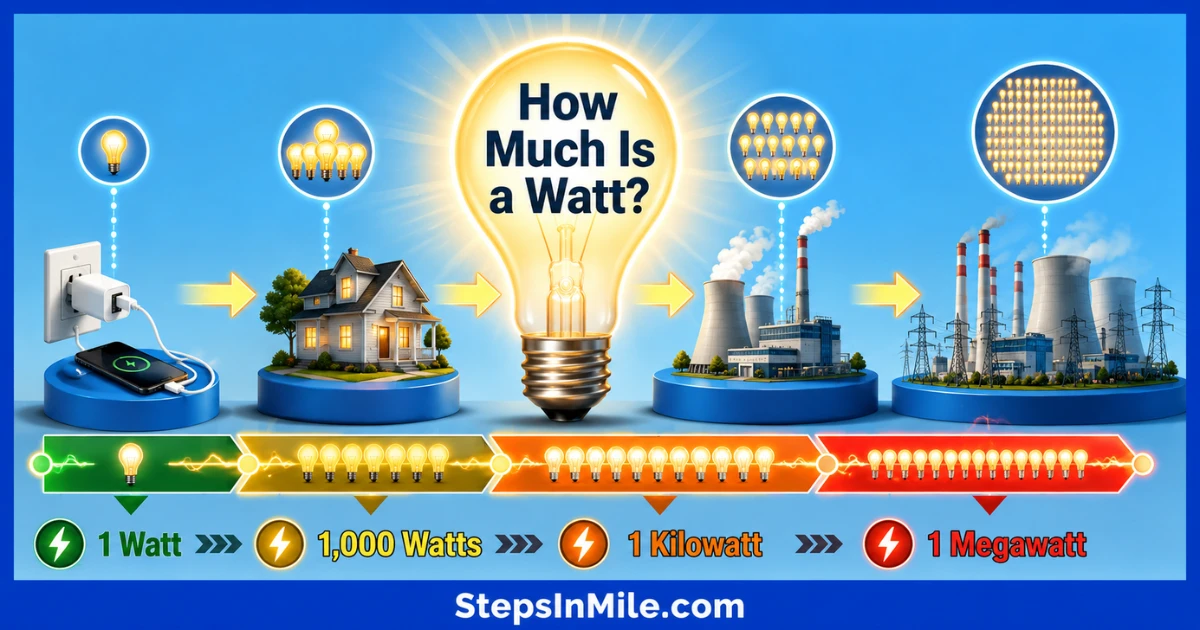
Most Americans pay monthly electricity bills without truly understanding what a watt actually measures. That changes right now. This guide breaks down watts, kilowatts, megawatts, horsepower, and even calories — so you finally see how all these power units connect to your real life.
What Is a Watt and How Much Is It, Really?
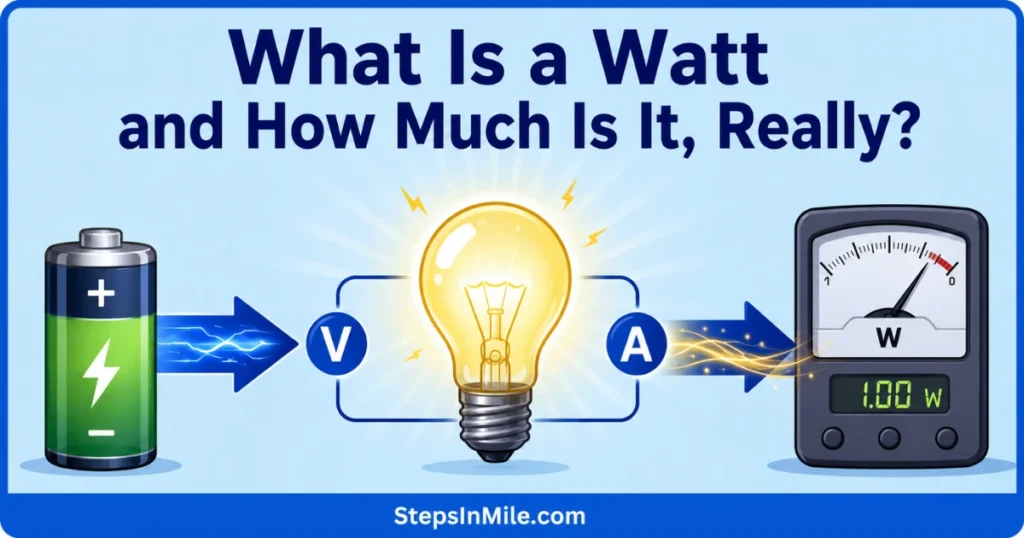
A watt (W) is the SI unit of power. It measures the rate at which energy flows — not the total energy itself.
Think of it this way. Power is the speed at which energy moves. Energy is the total amount that gets used. A watt tells you the speed. Your electricity bill tells you the total.
Officially, 1 watt = 1 joule per second. In electrical terms, it equals 1 volt multiplied by 1 ampere. Both definitions say the same thing — one watt is a small but precise rate of energy transfer.
Watt vs. Kilowatt vs. Megawatt — The Power Scale Explained
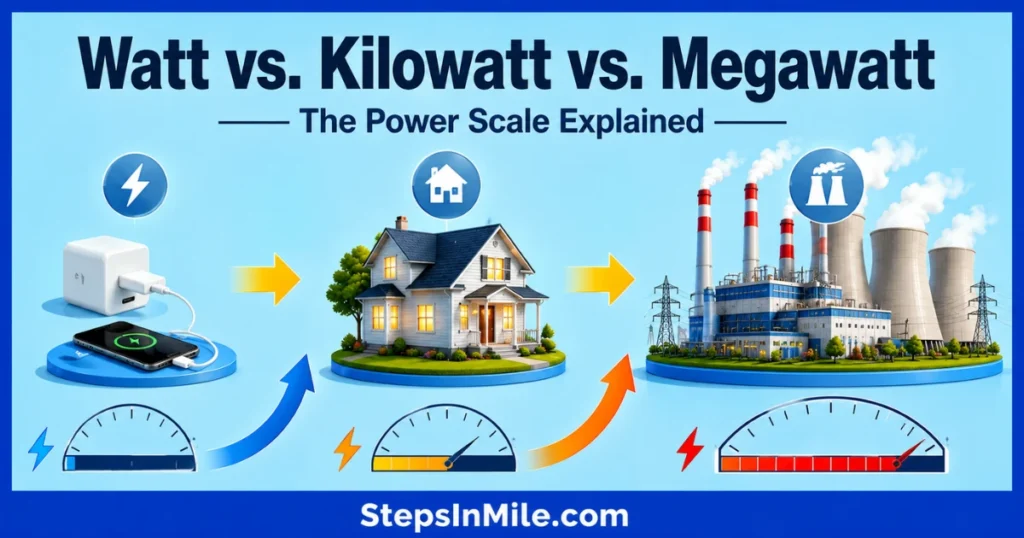
Power does not stay small. As devices and systems grow larger, the numbers scale up fast — and so do the units used to measure them.
Here is how the power scale works:
Common Watt Power Unit Conversions
- 1 kilowatt (kW) = 1,000 watts
- 1 megawatt (MW) = 1,000 kilowatts = 1,000,000 watts
- 1 gigawatt (GW) = 1,000 megawatts = 1,000,000,000 watts
Your phone charger runs at around 5–20 watts. Your home might draw 1–5 kilowatts at any moment. A coal power plant typically generates around 600 megawatts — enough to power hundreds of thousands of homes simultaneously.
How many watts in a kilowatt? Exactly 1,000. No more, no less. The prefix kilo always means one thousand in the metric system — just like a kilometer is 1,000 meters.
How many kilowatts in a megawatt? Again, exactly 1,000. The prefix mega means one million, so one megawatt equals 1,000 kilowatts or 1,000,000 watts.
What Makes a Watt Different from a Watt-Hour?
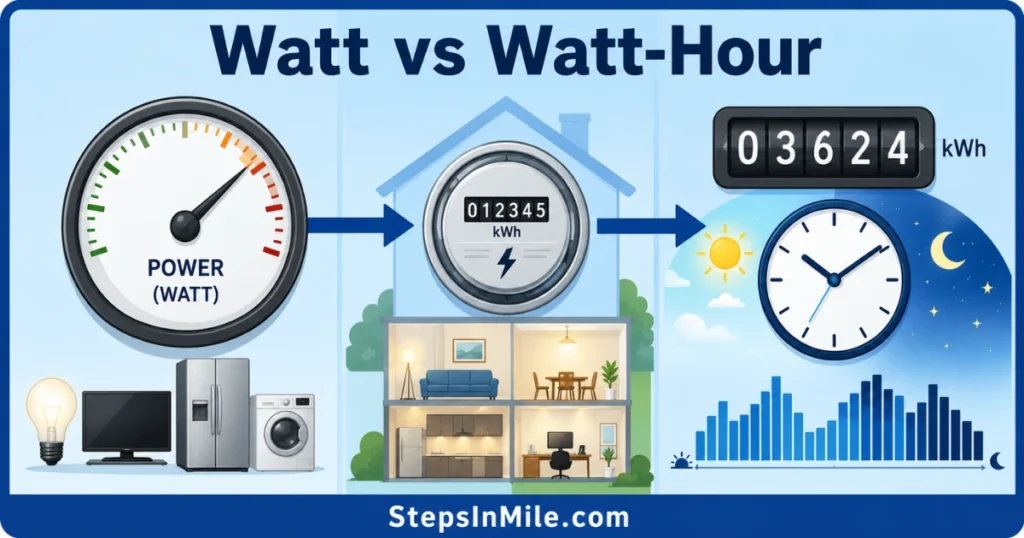
This is the most misunderstood concept in residential energy.
A watt is a snapshot of power right now — like your car’s speedometer showing 60 mph at this exact moment.
A watt-hour (Wh) is the total energy consumed over time — like your odometer tracking how many miles you have actually driven.
So when your utility company charges you for electricity, they are not charging per watt. They are charging per kilowatt-hour (kWh) — the total energy your home consumed over an entire month.
Power (watts) × Time (hours) = Energy (watt-hours)
The U.S. Energy Information Administration (EIA) reports that the average American household uses approximately 877 kWh of electricity per month. That is the energy measurement — not the power measurement.
Watts to Kilowatts — Conversion Formula, Shortcut and Quick-Reference Data
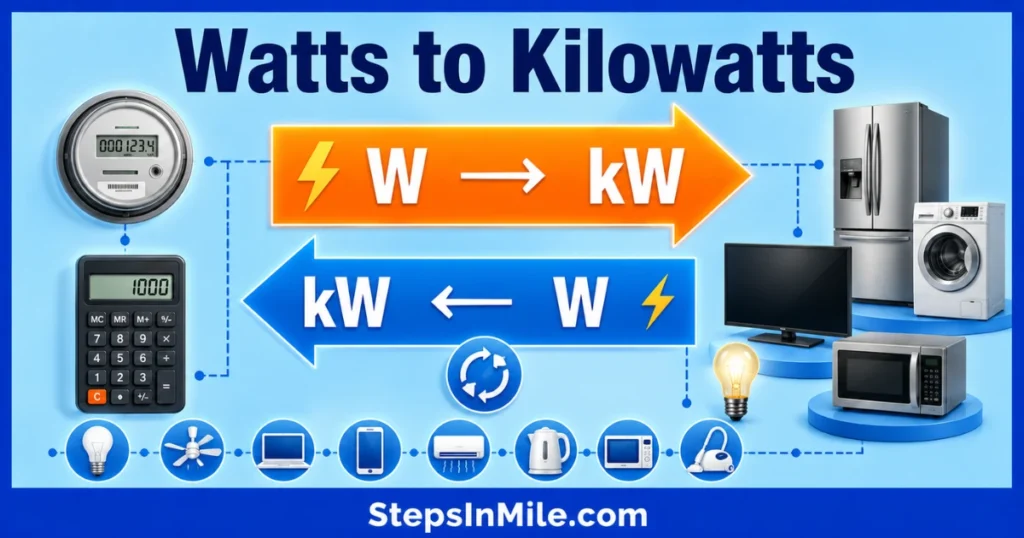
Converting between watts and kilowatts is one of the most practical skills an energy-conscious American can have. It lets you estimate your electricity costs before the bill arrives.
The Watts-to-Kilowatts Formula (With 3 Worked Examples)
How to Convert Watts (W) to Kilowatts (kW)
Formula:
Mental Shortcut:
Move the decimal point three places to the left. For example, 1,500 becomes 1.5.
Example 1 — Dishwasher (1,500W)
Example 2 — Microwave (700W)
Example 3 — LED Light Bulb (10W)
To reverse the conversion — kilowatts back to watts — simply multiply by 1,000.
P(W) = P(kW) × 1,000
Power Unit Conversion — Watts, Kilowatts and Megawatts Side by Side
Watts, Horsepower and Calories
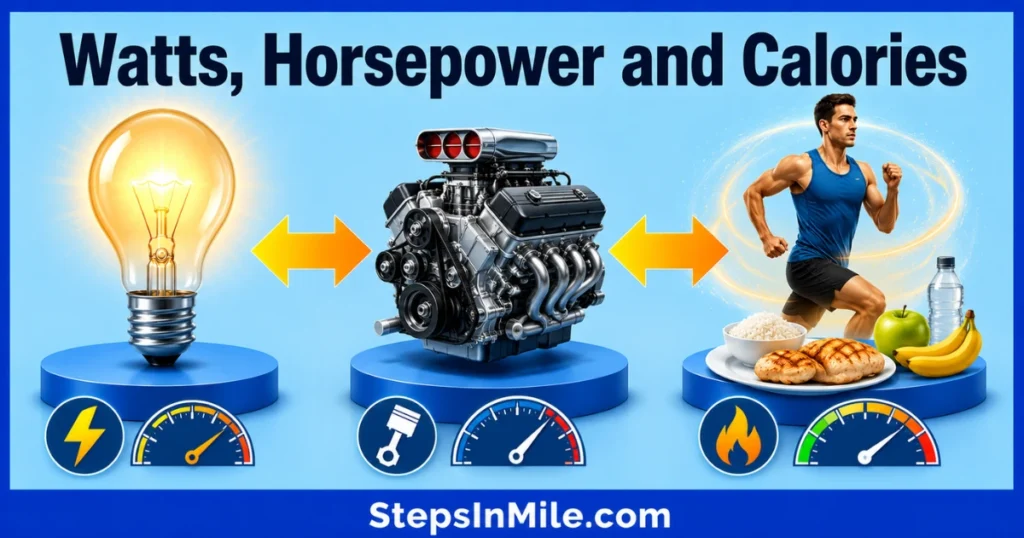
Watts are not the only unit humans use to measure power. Horsepower measures mechanical power in engines. Calories measure chemical energy in food. All three describe the same underlying concept — the rate at which energy moves or transforms. They just operate in different worlds.
Understanding how they connect gives you a rare, unified picture of power that most people never see.
How Many Watts in a Horsepower?
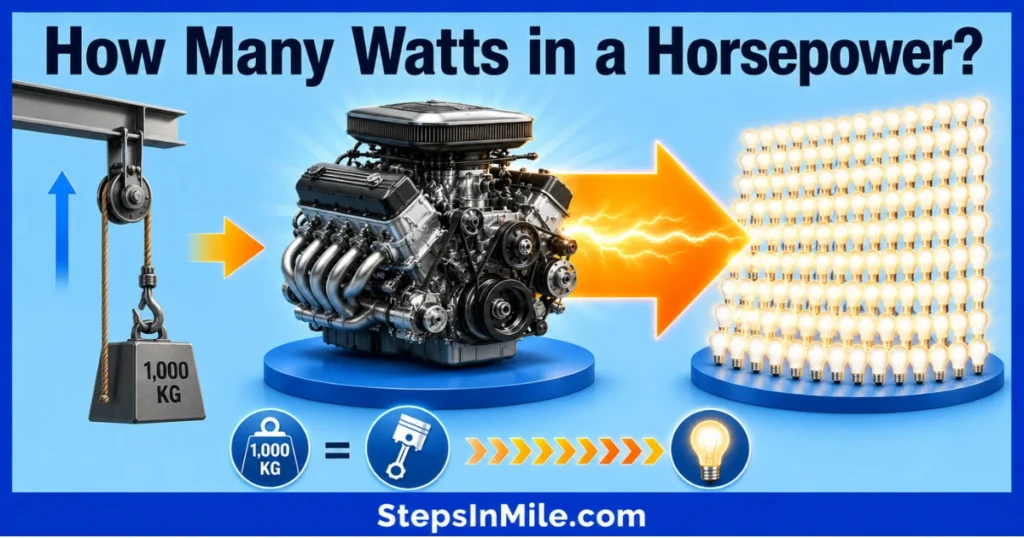
1 mechanical horsepower = 745.7 watts (commonly rounded to 746 watts).
How to Convert Horsepower (HP) to Watts (W)
Formula:
Shortcut:
Multiply horsepower by 746 for a fast and highly accurate estimate.
Worked Example — 200 HP Car Engine:
200 × 746 = 149,200 watts
149,200 ÷ 1,000 = 149.2 kilowatts
Answer: A 200 HP engine produces approximately 149,200 watts or 149.2 kW of power.
That 200-horsepower engine produces the same power as running nearly 15,000 LED light bulbs simultaneously. That is the scale of mechanical power hiding inside a typical American family sedan.
James Watt himself invented the concept of horsepower in the late 1700s. He needed a way to explain the power of his steam engine to farmers and merchants who only understood mill horses. He calculated that one horse could perform approximately 33,000 foot-pounds of work per minute — and used that as his baseline.
That original definition is still the basis of the mechanical horsepower unit used in automotive engineering and industrial motor ratings across the United States today.
How much is a horsepower in practical terms? One horsepower equals the power needed to lift 550 pounds by one foot in one second. It is also equal to approximately 2,545 BTUs per hour — a unit you will see on HVAC systems and heating equipment across the country.
How Many Calories Equal 1 Watt? Your Body Is a Power Plant
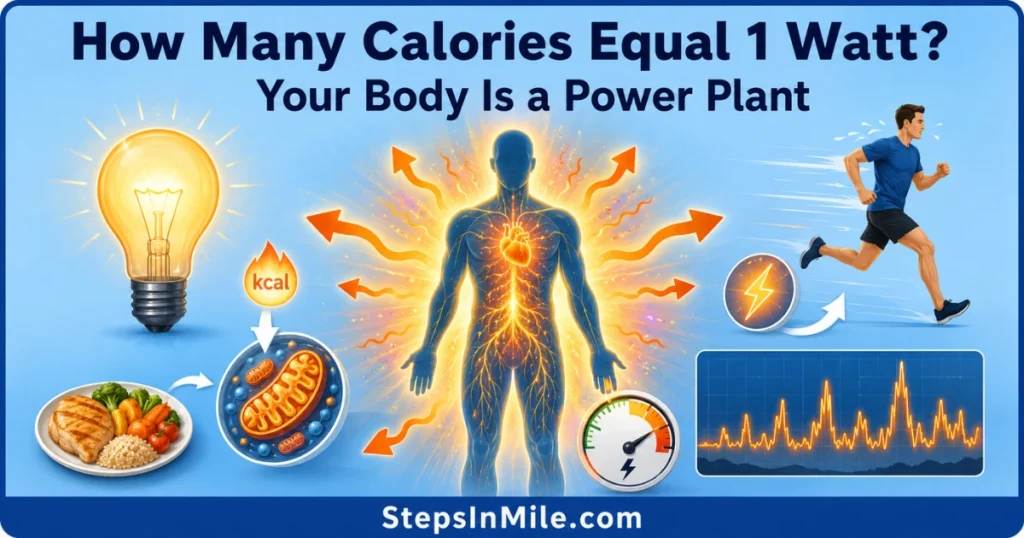
Most Americans think of calories as diet numbers. In physics, a calorie is a unit of energy — specifically, the amount of energy needed to raise 1 gram of water by 1°C.
Here is where it gets important: how many calories in a kilocalorie?
1 kilocalorie (kcal) = 1,000 calories (cal)
The “calories” printed on every U.S. food label are actually kilocalories. When a granola bar says 200 calories, it contains 200 kcal — or 200,000 true calories. This is defined by the U.S. Food and Drug Administration (FDA).
How much is a calorie in energy terms?
1 kilocalorie = 4,184 joules of energy
Now here is the fascinating part — converting that to watts:
Calculating Power from Energy and Time
Formula:
Worked Example — Human Body at Rest:
The average human body at rest uses approximately 100 joules of energy per second.
Power = 100 J ÷ 1 s
Power = 100 watts
Answer: A resting human body produces and consumes roughly 100 watts of power, similar to a bright incandescent light bulb.
The average adult at rest burns approximately 80 kilocalories per hour — a figure well-established in metabolic physiology research.
334,720 ÷ 3,600 seconds = approximately 93 watts
Your body, sitting still, produces nearly the same amount of heat as a 100-watt vintage incandescent light bulb. During intense physical exercise, that output can climb to 1,000 watts or more — rivaling a microwave oven running at full power.
This is why packed concert venues and crowded gyms feel so hot. Every human body in the room is radiating roughly 80–100 watts of thermal power at all times.
The connection between food energy, mechanical power, and electrical watts is the same physics operating across different scales — and it is the reason James Watt’s original unit became the universal language of power across all science.
FAQ about Watts
How many watts in a kilowatt?
There are 1,000 watts in 1 kilowatt (kW). Divide any watt value by 1,000 to convert it to kilowatts.
How many kilowatts in a megawatt?
There are 1,000 kilowatts in 1 megawatt (MW). One megawatt also equals 1,000,000 watts.
How many watts in a horsepower?
1 mechanical horsepower = 745.7 watts, commonly rounded to 746W. A 300HP engine produces roughly 223,800 watts.
How many calories in a kilocalorie?
1 kilocalorie (kcal) = 1,000 calories. All calorie counts on U.S. nutrition labels are kilocalories.
How much is a watt?
1 watt = 1 joule per second. In electrical terms, it equals 1 volt multiplied by 1 ampere. It is the standard SI unit of power.
How much is a horsepower?
1 horsepower = 745.7 watts, or the power to lift 550 pounds by one foot in one second. It was defined by James Watt in the 18th century to benchmark steam engine output.
How much is a calorie?
1 dietary calorie (kcal) = 4,184 joules of energy. In power terms, burning 1 kcal per hour equals approximately 1.16 watts of continuous power output.
Conclusion
A watt is not just a number on a light bulb box. It is the foundation of every electricity bill, every appliance rating, every engine spec, and every calorie count on your food label. One watt = 1,000 milliwatts. 1,000 watts = 1 kilowatt. 1,000 kilowatts = 1 megawatt. 746 watts = 1 horsepower. 4,184 joules = 1 kilocalorie.
Once you understand how much a watt is — and how it connects to kilowatts, horsepower, and calories — you hold the key to reading your energy bill clearly, choosing appliances smartly, and cutting your electricity costs month after month. Start with your biggest energy users — your air conditioner, water heater, and refrigerator. Run the monthly cost formula. The numbers will surprise you — and motivate you to act.

Fitness guru and lead author, crafting every post with passion. Certified trainer dedicated to your online fitness journey—empowering steps toward a healthier you!