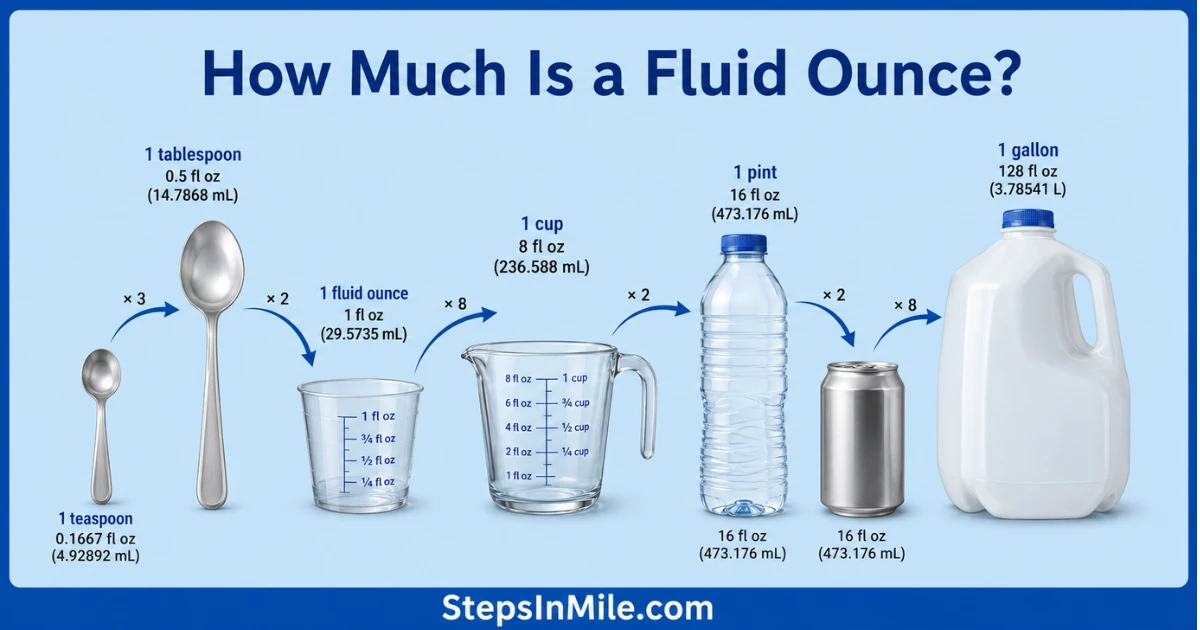
You see fl oz on water bottles, medicine cups, soda cans, and recipe cards every single day. But most people never stop to ask — how much actually is a fluid ounce? This guide answers that question completely, with real numbers, real examples, and zero confusion.
How Much Is a Fluid Ounce
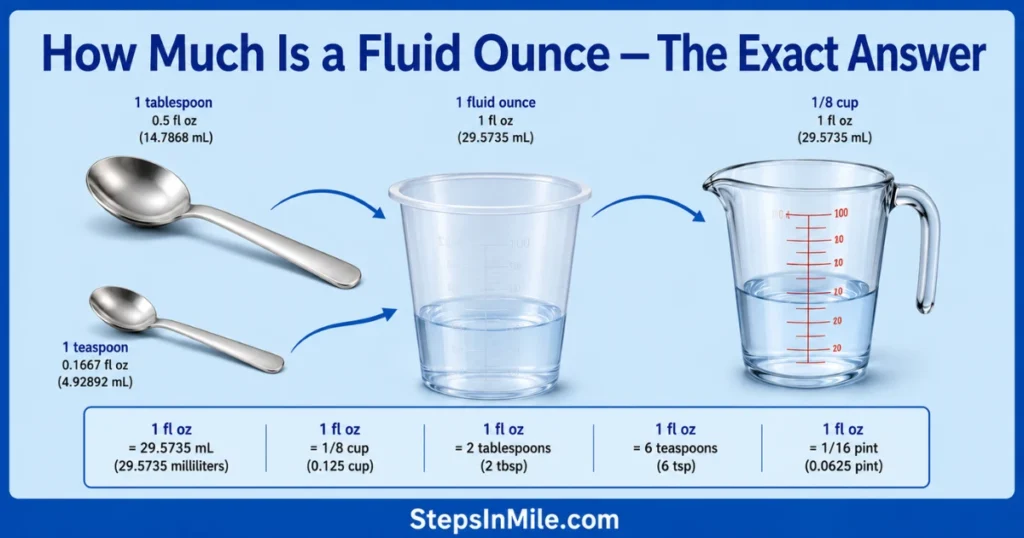
A fluid ounce (abbreviated fl oz) is a unit of liquid volume in the US customary system of measurement.
One US fluid ounce is equal to:
Common US Fluid Ounce Equivalents
- 29.5735 milliliters (mL) — the precise scientific value
- 1/8 of a US cup
- 2 US tablespoons
- 6 US teaspoons
- 1/16 of a US liquid pint
According to the National Institute of Standards and Technology (NIST), the US fluid ounce is defined as exactly 29.5735295625 mL. For everyday use, most people round it to 29.57 mL or use the FDA food labeling standard of exactly 30 mL.
The term “fluid ounce” exists specifically to separate volume measurement from weight measurement. When someone says “ounce” without the word “fluid,” they mean mass — not volume. These are two completely different things.
US Fluid Ounce vs. Imperial Fluid Ounce — Which One Are You Using?
This is the detail most blogs skip entirely — and it matters more than you think.
There are two different fluid ounces in use worldwide:
- US fluid ounce (US fl oz): 29.5735 mL — used in the United States
- Imperial fluid ounce (Imp fl oz): 28.4131 mL — used in the United Kingdom, Canada, and other countries that follow the British Imperial system
The difference is small — only about 1.36 mL — but it adds up fast in large quantities. If you are following a British recipe or reading a UK product label, you are working with a slightly smaller fluid ounce than the American standard.
Here is the quick comparison:
US vs Imperial Fluid Ounce Relationships
- 1 US cup = 8 fl oz — 1 Imperial cup = 10 fl oz
- 1 US pint = 16 fl oz — 1 Imperial pint = 20 fl oz
- 1 US gallon = 128 fl oz — 1 Imperial gallon = 160 fl oz
For all conversions in this article, we use the US customary fluid ounce — the standard used across the United States.
Fluid Ounce Conversions, Formulas & Quick-Reference Chart
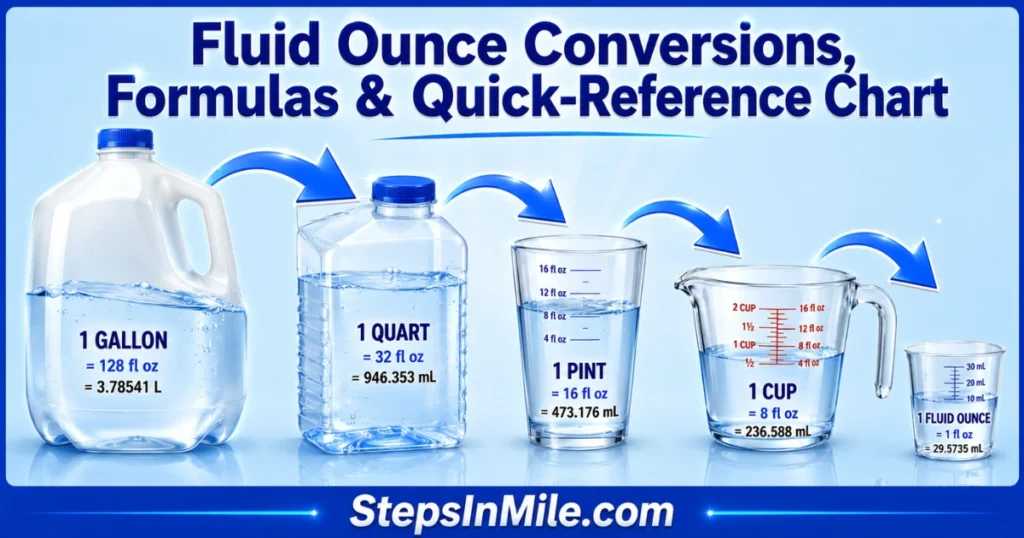
Every conversion works the same way. Multiply or divide using a fixed conversion factor. Once you know the formula, every fluid ounce conversion becomes simple.
The Universal Formula:
Fluid ounces × conversion factor = result
To go the other direction:
Measurement ÷ conversion factor = fluid ounces
Quick Estimation Shortcut: Multiply any fluid ounce value by 30 to get a fast milliliter estimate. It is slightly above the true value (29.5735 mL), but it matches the FDA’s food labeling rounding rule and works perfectly for everyday use.
How Many Fluid Ounces in a Cup
Cups to Fluid Ounces Formula
- Formula: cups × 8 = fl oz
- Shortcut: 1 cup = 8 fl oz — always
- Example: 3 cups of milk = 3 × 8 = 24 fl oz
How Many Fluid Ounces in a Pint
Pints to Fluid Ounces Formula
- Formula: pints × 16 = fl oz
- Shortcut: 1 pint = 2 cups = 16 fl oz
- Example: 2 pints of juice = 2 × 16 = 32 fl oz
How Many Fluid Ounces in a Quart
Quarts to Fluid Ounces Formula
- Formula: quarts × 32 = fl oz
- Shortcut: 1 quart = 2 pints = 4 cups = 32 fl oz
- Example: 1.5 quarts of broth = 1.5 × 32 = 48 fl oz
How Many Fluid Ounces in a Gallon
Gallons to Fluid Ounces Formula
- Formula: gallons × 128 = fl oz
- Shortcut: 1 gallon = 4 quarts = 8 pints = 16 cups = 128 fl oz
- Example: 2 gallons of water = 2 × 128 = 256 fl oz
How Many Milliliters in a Fluid Ounce
Fluid Ounce to Milliliter Formula
- Formula: fl oz × 29.5735 = mL (precise) or fl oz × 30 = mL (FDA estimate)
- Shortcut: Multiply fl oz by 30 for fast everyday math
- Example: 8 fl oz × 29.5735 = 236.59 mL (exact) or 8 × 30 = 240 mL (quick estimate)
The complete liquid measurement chain in the US customary system looks like this:
1 gallon → 4 quarts → 8 pints → 16 cups → 128 fluid ounces
Every unit breaks down cleanly into the one below it. Learn this chain once and you will never be confused by a US liquid measurement again.
Simple Conversion Shortcuts You Can Do Without a Calculator
You do not always have a calculator in the kitchen. These mental math tricks cover the most common situations:
- Tablespoons to fl oz: Divide tablespoons by 2 (2 tbsp = 1 fl oz)
- Teaspoons to fl oz: Divide teaspoons by 6 (6 tsp = 1 fl oz)
- Cups to fl oz: Multiply cups by 8
- fl oz to mL: Multiply by 30 for a fast, close result
- fl oz to cups: Divide by 8
- fl oz to pints: Divide by 16
These are the same shortcuts used by professional home cooks, registered dietitians, and food scientists working with US recipe standards daily.
How Big Is a Fluid Ounce? Real-Life Examples You Already Know
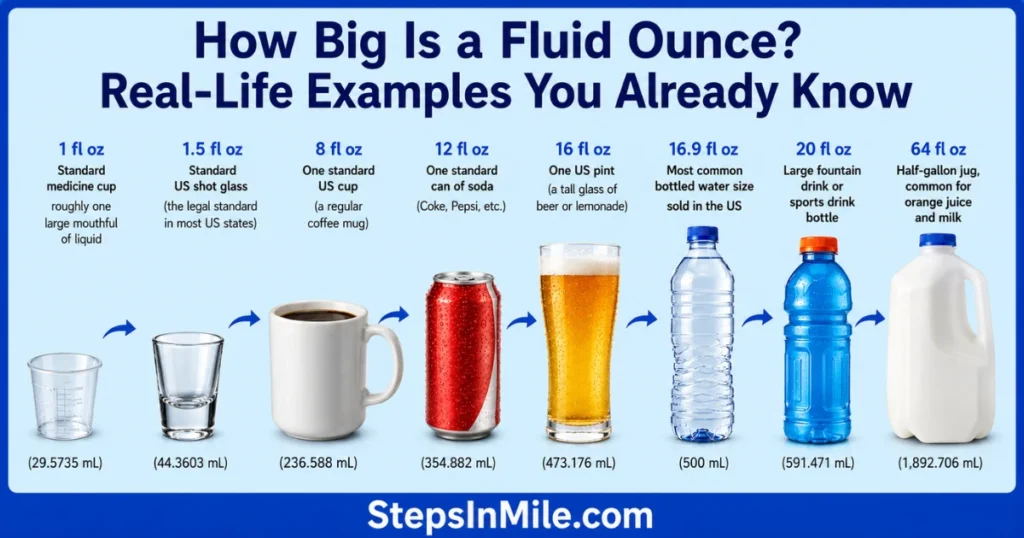
Numbers on paper only go so far. Here is what one fluid ounce actually looks like in real life — using objects you already own and use every day.
A standard medicine cup holds exactly 1 fl oz (30 mL). This is why pharmacists and nurses use the medicine cup as the baseline reference for liquid medication dosing. According to the FDA, one fluid ounce on a Nutrition Facts label is defined as exactly 30 mL — matching the medicine cup precisely.
Here are more everyday size anchors:
- 1 fl oz = a standard medicine cup = roughly one large mouthful of liquid
- 1.5 fl oz = a standard US shot glass (the legal standard in most US states)
- 8 fl oz = one standard US cup = a regular coffee mug
- 12 fl oz = one standard can of soda (Coke, Pepsi, etc.)
- 16 fl oz = one US pint = a tall glass of beer or lemonade
- 16.9 fl oz = the most common bottled water size sold in the US
- 20 fl oz = a large fountain drink or sports drink bottle
- 64 fl oz = a half-gallon jug, common for orange juice and milk
The next time you pick up a 12 fl oz soda can, you are holding exactly 12 times the volume of a single fluid ounce — or about 355 mL of liquid. It puts the unit into instant perspective.
Fluid Ounce vs. Weight Ounce — The Mistake That Confuses Everyone
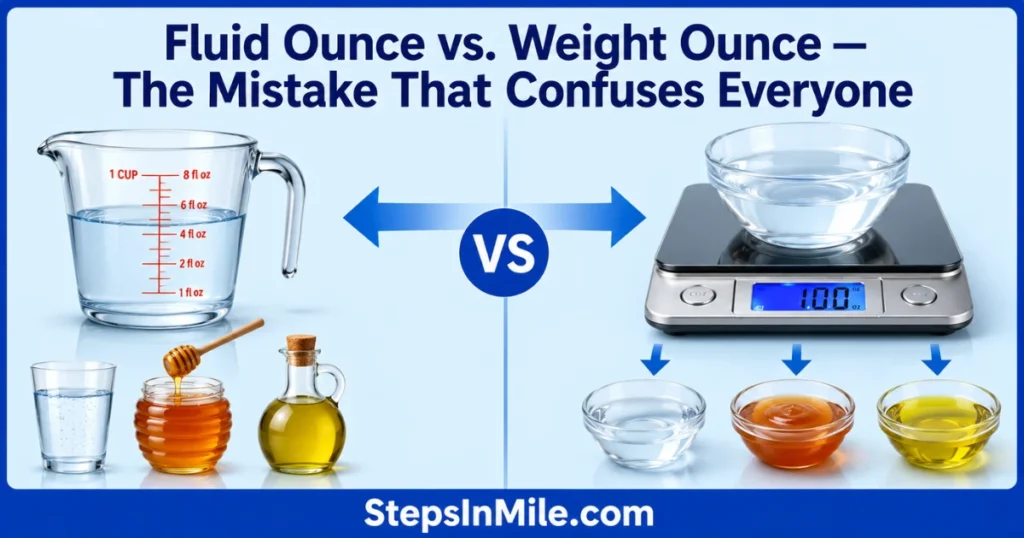
This is the most misunderstood part of the entire topic — and almost every competitor blog treats it as a side note. It is not.
A fluid ounce (fl oz) measures volume. It tells you how much space a liquid occupies.
An ounce (oz) measures weight or mass. It tells you how heavy something is.
These two units are completely different. Using them interchangeably is a mistake with real consequences — in cooking, in science, and on product labels.
Here is why this matters in practice:
- 8 fl oz of water weighs approximately 8.35 oz (236.6 g)
- 8 fl oz of honey weighs approximately 12 oz (340 g) — because honey is denser than water
- 8 fl oz of olive oil weighs approximately 7.6 oz — because oil is less dense than water
The same volume of different liquids will weigh different amounts. Volume and weight are only roughly equal for water — and even then, not exactly.
According to FDA label regulations on net quantity of contents:
- Liquid foods must be labeled by fluid measure (fl oz)
- Solid and semisolid foods must be labeled by weight (Net Wt oz)
- Viscous products like honey — which sit between liquid and solid — are labeled by weight
- Non-food liquids like lotions and dish soap are labeled in fluid ounces
This is why a bottle of shampoo says fl oz and a jar of peanut butter says Net Wt oz. They measure completely different properties of the product.
The abbreviation matters too. Always look for:
- fl oz → Volume of a liquid
- oz or Net Wt oz → Weight of a product
- g or mL → Metric equivalents shown on the same label
How to Measure a Fluid Ounce at Home (With or Without a Measuring Cup)
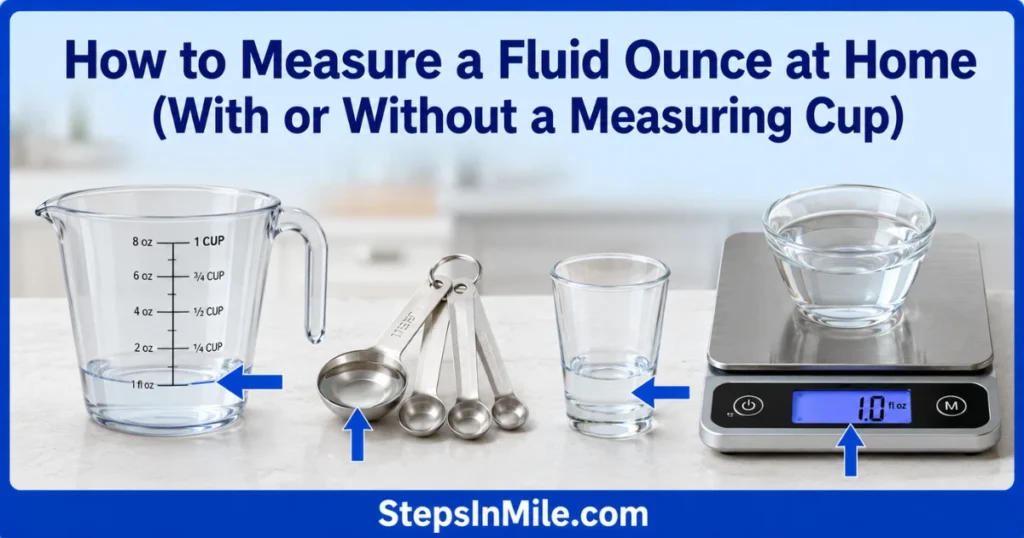
You do not need special equipment to measure fluid ounces accurately at home. Here are three reliable methods:
Method 1 — Liquid Measuring Cup
Use a clear glass or plastic liquid measuring cup with fl oz markings on the side. Fill with your liquid and read the measurement at eye level — not from above. Reading from above causes a parallax error that skews your measurement. This is the most accurate method for volumes above 2 fl oz.
Method 2 — Measuring Spoons
For small amounts under 2 fl oz, measuring spoons are faster and just as accurate.
- 2 US tablespoons = 1 fluid ounce (fl oz)
- 6 US teaspoons = 1 fluid ounce (fl oz)
Pour your liquid into a tablespoon twice — you have 1 fluid ounce.
Method 3 — A Kitchen Scale (for water-based liquids)
For water and most thin, water-based liquids, weight and volume are close enough to use a digital kitchen scale as a proxy:
- 1 fl oz of water ≈ 29.57 grams
- Quick estimate: Weigh 30 grams of water = approximately 1 fl oz
This only works reliably for water and liquids with a similar density. Do not use this method for oil, honey, syrup, or anything significantly denser or lighter than water.
The FDA Labeling Rule — What the Number on the Bottle Actually Means
Here is a nuance almost no other blog mentions. When you see “1 fl oz = 30 mL” on a US nutrition label, that is not the scientifically precise value. The FDA rounds 29.5735 mL up to exactly 30 mL for label printing purposes. The true value and the label value differ by 0.4265 mL per ounce. For small amounts, this is negligible. For large industrial batches, this rounding is carefully accounted for in food manufacturing and pharmaceutical compounding.
FAQ’s About Fluid Ounces
How Many Fluid Ounces in a Cup?
1 US cup = 8 fluid ounces. To convert cups to fl oz, multiply the number of cups by 8.
How Many Fluid Ounces in a Pint?
1 US liquid pint = 16 fluid ounces. Note: 1 Imperial pint = 20 fl oz — a different measurement used in the UK.
How Many Fluid Ounces in a Quart?
1 US liquid quart = 32 fluid ounces. One quart equals 2 pints, 4 cups, or 32 fl oz.
How Many Fluid Ounces in a Gallon?
1 US gallon = 128 fluid ounces. One gallon breaks down into 4 quarts, 8 pints, or 16 cups.
How Many Milliliters in a Fluid Ounce?
1 US fluid ounce = 29.5735 mL (precise). The FDA rounds this to 30 mL on nutrition labels. The Imperial fluid ounce = 28.4131 mL.
How Much Is a Fluid Ounce?
1 US fluid ounce = 29.5735 mL = 2 tablespoons = 6 teaspoons = 1/8 cup. It is the standard small liquid unit in the US customary system.
How Big Is a Fluid Ounce?
One fluid ounce is about the size of a standard medicine cup — roughly one large mouthful of liquid, or exactly 2 tablespoons of any liquid.
Conclusion
A fluid ounce is one of the most practical units of measurement in everyday American life. It measures liquid volume — not weight — and equals 29.5735 mL, 2 tablespoons, or 1/8 of a US cup. The full US liquid measurement chain — 128 fl oz to a gallon, 32 fl oz to a quart, 16 fl oz to a pint, and 8 fl oz to a cup — is simple once you see it laid out. Bookmark the ×30 shortcut for milliliters, remember the 2-tablespoon rule for small pours, and never confuse fl oz (volume) with oz (weight) again. You now have everything you need to measure, convert, and use fluid ounces with total confidence.

Fitness guru and lead author, crafting every post with passion. Certified trainer dedicated to your online fitness journey—empowering steps toward a healthier you!