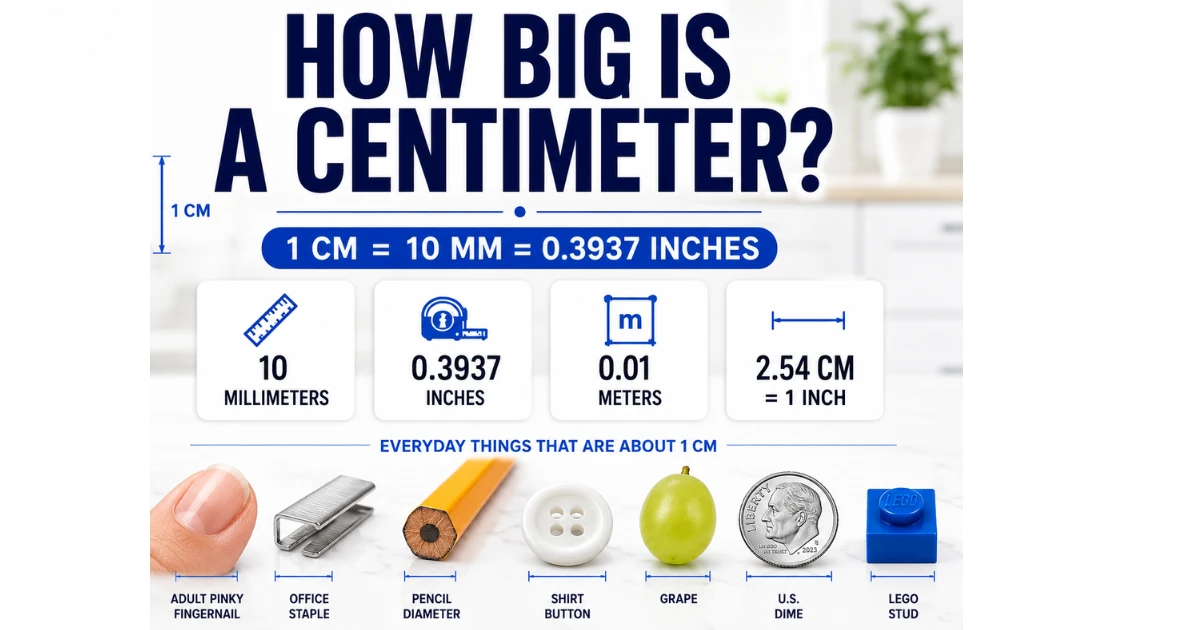
| 1 centimeter is exactly 10 millimeters, 0.3937 inches, or 0.01 meters — roughly the width of an adult pinky fingernail. . |
|---|
Once you can picture exactly how big a centimeter is, you’ll never feel lost between metric and imperial units again.
How Big Is a Centimeter
A centimeter is a small unit of length equal to 0.39 inches or 10 millimeters.
It’s about the width of a standard pencil or the thickness of your pinky finger nail.
Key reference facts at a glance:
- 1 cm = 10 millimeters
- 1 cm = 0.3937 inches
- 1 cm = 0.01 meters
- 1 inch = 2.54 centimeters
How Many Millimeters in a Centimeter
1 centimeter equals exactly 10 millimeters. This is one of the cleanest relationships in the entire metric system — no rounding, no approximation.
Formula: cm × 10 = mm
Shortcut: Just add a zero. 3 cm = 30 mm. Done.
Worked Example: You have a wound that is 2.5 cm long. In millimeters, that is 2.5 × 10 = 25 mm.
A practical anchor: picture a single grain of rice, which is roughly 1 millimeter wide. Line up ten grains side by side — that total span is exactly 1 centimeter.
| Centimeter | Millimeters |
|---|---|
| 1 cm | 10 mm |
| 2 cm | 20 mm |
| 3 cm | 30 mm |
| 4 cm | 40 mm |
| 5 cm | 50 mm |
| 6 cm | 60 mm |
| 7 cm | 70 mm |
| 8 cm | 80 mm |
| 9 cm | 90 mm |
| 10 cm | 100 mm |
| 11 cm | 110 mm |
| 12 cm | 120 mm |
| 13 cm | 130 mm |
| 14 cm | 140 mm |
| 15 cm | 150 mm |
| 16 cm | 160 mm |
| 17 cm | 170 mm |
| 18 cm | 180 mm |
| 19 cm | 190 mm |
| 20 cm | 200 mm |
| 21 cm | 210 mm |
| 22 cm | 220 mm |
| 23 cm | 230 mm |
| 24 cm | 240 mm |
| 25 cm | 250 mm |
| 26 cm | 260 mm |
| 27 cm | 270 mm |
| 28 cm | 280 mm |
| 29 cm | 290 mm |
| 30 cm | 300 mm |
| 31 cm | 310 mm |
| 32 cm | 320 mm |
| 33 cm | 330 mm |
| 34 cm | 340 mm |
| 35 cm | 350 mm |
| 36 cm | 360 mm |
| 37 cm | 370 mm |
| 38 cm | 380 mm |
| 39 cm | 390 mm |
| 40 cm | 400 mm |
| 41 cm | 410 mm |
| 42 cm | 420 mm |
| 43 cm | 430 mm |
| 44 cm | 440 mm |
| 45 cm | 450 mm |
| 46 cm | 460 mm |
| 47 cm | 470 mm |
| 48 cm | 480 mm |
| 49 cm | 490 mm |
| 50 cm | 500 mm |
How Many Inches in a Centimeter
1 centimeter equals approximately 0.3937 inches. Flipped around, 1 inch equals exactly 2.54 centimeters — a conversion defined by the National Institute of Standards and Technology (NIST).
Formula: cm × 0.3937 = inches
Shortcut (The 2.54 Trick): To go from inches to centimeters, multiply by 2.54. To go from centimeters to inches, divide by 2.54.
Worked Example: A phone screen is 15 cm wide. In inches: 15 ÷ 2.54 = 5.9 inches.
| Centimeter | Inches |
|---|---|
| 1 cm | 0.39 in |
| 2 cm | 0.79 in |
| 3 cm | 1.18 in |
| 4 cm | 1.57 in |
| 5 cm | 1.97 in |
| 6 cm | 2.36 in |
| 7 cm | 2.76 in |
| 8 cm | 3.15 in |
| 9 cm | 3.54 in |
| 10 cm | 3.94 in |
| 11 cm | 4.33 in |
| 12 cm | 4.72 in |
| 13 cm | 5.12 in |
| 14 cm | 5.51 in |
| 15 cm | 5.91 in |
| 16 cm | 6.30 in |
| 17 cm | 6.69 in |
| 18 cm | 7.09 in |
| 19 cm | 7.48 in |
| 20 cm | 7.87 in |
| 21 cm | 8.27 in |
| 22 cm | 8.66 in |
| 23 cm | 9.06 in |
| 24 cm | 9.45 in |
| 25 cm | 9.84 in |
| 26 cm | 10.24 in |
| 27 cm | 10.63 in |
| 28 cm | 11.02 in |
| 29 cm | 11.42 in |
| 30 cm | 11.81 in |
| 31 cm | 12.20 in |
| 32 cm | 12.60 in |
| 33 cm | 12.99 in |
| 34 cm | 13.39 in |
| 35 cm | 13.78 in |
| 36 cm | 14.17 in |
| 37 cm | 14.57 in |
| 38 cm | 14.96 in |
| 39 cm | 15.35 in |
| 40 cm | 15.75 in |
| 41 cm | 16.14 in |
| 42 cm | 16.54 in |
| 43 cm | 16.93 in |
| 44 cm | 17.32 in |
| 45 cm | 17.72 in |
| 46 cm | 18.11 in |
| 47 cm | 18.50 in |
| 48 cm | 18.90 in |
| 49 cm | 19.29 in |
| 50 cm | 19.69 in |
How Long Is a Centimeter ?
A centimeter is equal to 0.39 inches or 10 millimeters. It’s about the width of a fingernail or a small paperclip.
Each example below has a verified measurement so you’re working with real data, not rough guesses.
All Shortcuts at a Glance
| CONVERSION | RULE |
|---|---|
| cm → mm | Multiply by 10 |
| cm → inches | Divide by 2.54 |
| cm → feet | Divide by 30.48 |
| cm → meters | Divide by 100 |
| cm → yards | Divide by 91.44 |
| cm → km | Divide by 100,000 |
| inches → cm | Multiply by 2.54 |
| mm → cm | Divide by 10 |
| feet → cm | Multiply by 30.48 |
| meters → cm | Multiply by 100 |
7 Everyday Objects That Prove It
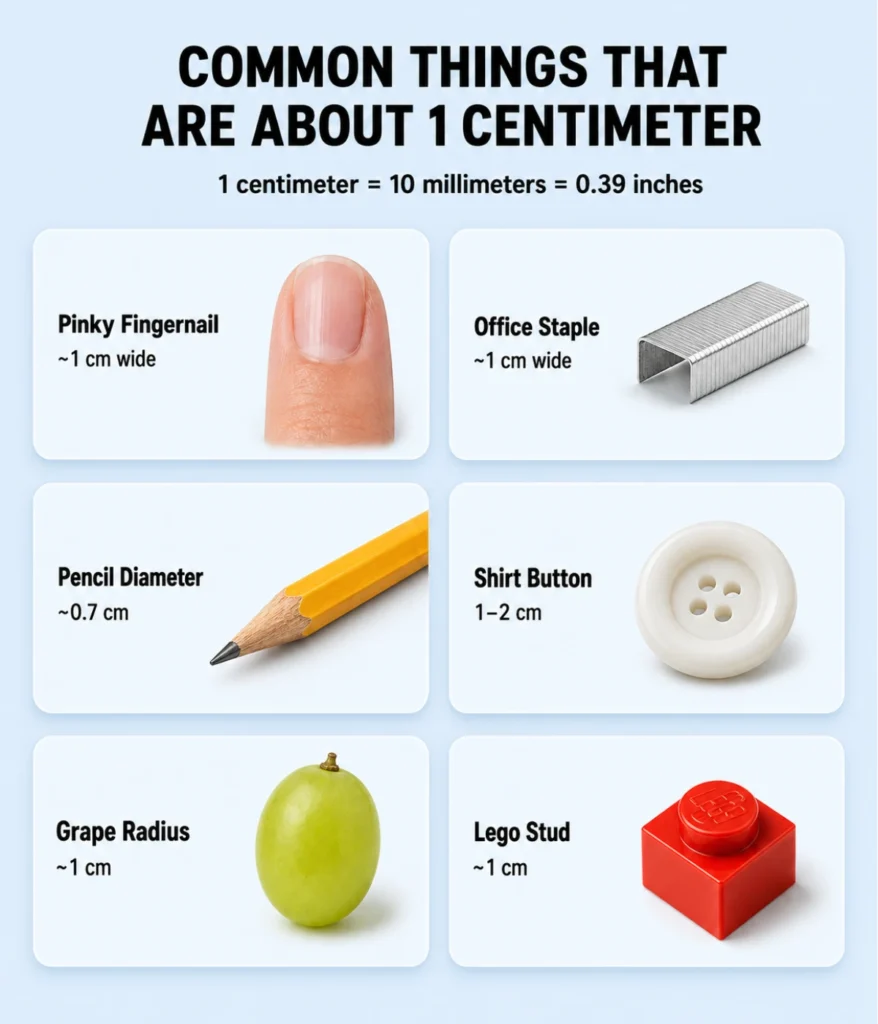
1. Your Pinky Fingernail (~1 cm)
The width of an adult pinky fingernail measures approximately 1 centimeter. This is the gold-standard reference used in healthcare and nursing education for estimating wound size, skin lesion diameter, and more.
Your hand is always with you — making this the most accessible measuring tool on earth.
2. A Standard Office Staple (~1 cm wide)
A regular 23/6 staple — the kind loaded into any Swingline or Bostitch stapler — measures almost exactly 1 cm across when closed.
It’s dimensionally consistent and sits on millions of American desks. Next time you need a quick centimeter reference, reach for the staple tray.
3. The Diameter of a Pencil (~0.7 cm)
A standard #2 pencil has a diameter of approximately 7 millimeters — just under 1 centimeter. Since 10 mm = 1 cm, the pencil gives a very close visual anchor.
Regular ballpoint pens run similarly close to 1 cm in width.
4. A Shirt Button (1–2 cm)
A standard dress shirt button ranges from 1 cm to 2 cm in diameter, depending on its position on the garment. Collar buttons sit at the smaller end; mid-chest buttons run closer to 1.5 cm.
Tailors and seamstresses default to centimeter measurements — making the shirt button one of the most tactile centimeter references in everyday American life.
5. The Radius of a Grape (~1 cm)
A standard table grape — whether a Thompson Seedless, Concord, or Red Globe variety — measures roughly 2–3 cm in diameter at its widest point.
That means its radius is approximately 1 centimeter. This is also why oncologists and radiologists describe certain masses as “the size of a grape,” giving patients an immediate physical scale to understand.
6. A U.S. Dime (~1.8 cm diameter)
The United States dime, issued by the U.S. Mint, has an officially standardized diameter of 17.91 mm — approximately 1.8 centimeters.
Because its dimensions are federally regulated, the dime is one of the most dimensionally reliable everyday objects in America. Pull one out of your pocket and you’ve got an instant sub-2 cm reference.
7. A Lego Stud (~1 cm)
A standard 2×4 Lego brick measures 1.6 cm × 3.2 cm × 1.1 cm. The depth of a single Lego stud is approximately 1 centimeter.
It’s a familiar, tactile reference — especially useful for parents and kids learning metric measurement together.
How to Measure a Centimeter Without a Ruler
No ruler? No problem. Here are three reliable methods used by professionals and everyday people alike.
The Body Ruler Method
- Pinky fingernail width ≈ 1 cm
- Thumb width at the knuckle ≈ 2.5 cm (roughly 1 inch)
- Width of your index finger ≈ 2 cm
- Knuckle to tip of your index finger ≈ 5 cm
This technique is taught in first-aid training, field medicine, and nursing programs across the USA. According to nursing educators, the body ruler method provides estimates accurate enough for clinical triage when measuring tools aren’t immediately available.
The Coin Method
- U.S. Dime = 1.79 cm diameter
- U.S. Penny = 1.9 cm diameter
- U.S. Quarter = 2.4 cm diameter
All U.S. coin dimensions are standardized by the U.S. Mint, making them reliable, consistent measuring references you carry every day.
The Finger Stack Method
Stack your four fingers together (index through pinky) flat against a surface.
The total width of a relaxed adult hand across these four fingers is approximately 7–8 cm. Divide that visually — each finger represents roughly 1.75–2 cm.
FAQ’s About How Big a Centimeter Is
How big is a centimeter ?
1 centimeter is 10 millimeters, 0.39 inches, or 0.01 meters — about the width of an adult pinky fingernail.
How many millimeters in a centimeter ?
Exactly 10 millimeters equal 1 centimeter. Multiply centimeters by 10 to get millimeters.
How many inches in a centimeter ?
1 centimeter equals approximately 0.3937 inches. One inch equals exactly 2.54 centimeters.
How long is a centimeter ?
A centimeter is about as long as a standard office staple or the diameter of a pencil — small but clearly visible to the naked eye.
How much is a centimeter ?
1 centimeter is one-hundredth of a meter and 10 millimeters — a precise metric unit used daily in medicine, fashion, engineering, and cooking.
Conclusion
Understanding how big a centimeter is unlocks a measurement language used by doctors, engineers, chefs, and tailors worldwide.
Whether you use your pinky fingernail, a U.S. dime, or a shirt button, you now have reliable, always-available tools to estimate centimeter measurements without a ruler. The metric system isn’t foreign — it’s already all around you. Master your centimeter references and you’ll move confidently between imperial and metric units in any real-world situation.

Fitness guru and lead author, crafting every post with passion. Certified trainer dedicated to your online fitness journey—empowering steps toward a healthier you!