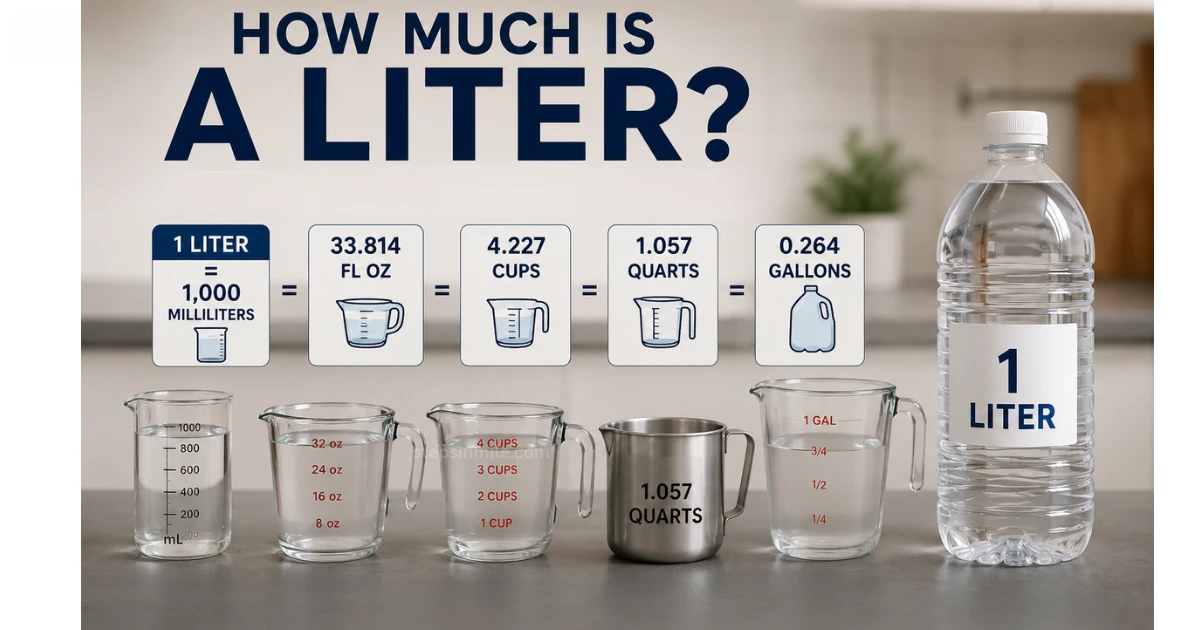
| A liter equals exactly 1,000 milliliters — the world’s most widely used unit of liquid volume in cooking, medicine, hydration, and fuel measurement. . |
|---|
Whether you’re scaling a recipe, tracking your daily water intake, or converting units for a science class, knowing how much is a liter saves you from real-world measurement mistakes. This guide covers every major conversion, real-life examples you can actually picture, and the practical shortcuts you’ll use every day.
How Much Is a Liter ?
A liter is a metric unit used to measure liquid volume, equal to 1,000 milliliters or about 33.8 fluid ounces.
It’s roughly the size of a standard water bottle or a small soda bottle.
Here is how 1 liter stacks up at a glance:
| Volume Conversion | Equivalent Value |
|---|---|
| 1 L | 1,000 mL (milliliters) |
| 1 L | 33.814 fl oz (U.S. fluid ounces) |
| 1 L | 4.227 cups (U.S. customary cups) |
| 1 L | 1.057 quarts (U.S. liquid quarts) |
| 1 L | 0.264 gallons (U.S. gallons) |
How Many Gallons in a Liter
1 liter = 0.264172 U.S. gallons.
Formula:
It takes just under 4 full liters to equal one U.S. gallon. This conversion matters most when filling gas tanks, comparing water jugs, or working with agricultural irrigation volumes.
Gallons = Liters × 0.264172
Shortcut: Multiply liters by 0.26 for a fast estimate. You’ll land within 1% accuracy every time.
Worked Example:
5 liters × 0.264172 = 1.32 gallons
| Liters | Gallons |
|---|---|
| 1 L | 0.26 gal |
| 2 L | 0.53 gal |
| 3 L | 0.79 gal |
| 4 L | 1.06 gal |
| 5 L | 1.32 gal |
| 6 L | 1.59 gal |
| 7 L | 1.85 gal |
| 8 L | 2.11 gal |
| 9 L | 2.38 gal |
| 10 L | 2.64 gal |
| 11 L | 2.91 gal |
| 12 L | 3.17 gal |
| 13 L | 3.43 gal |
| 14 L | 3.70 gal |
| 15 L | 3.96 gal |
| 16 L | 4.23 gal |
| 17 L | 4.49 gal |
| 18 L | 4.76 gal |
| 19 L | 5.02 gal |
| 20 L | 5.28 gal |
| 21 L | 5.55 gal |
| 22 L | 5.81 gal |
| 23 L | 6.08 gal |
| 24 L | 6.34 gal |
| 25 L | 6.60 gal |
| 26 L | 6.87 gal |
| 27 L | 7.13 gal |
| 28 L | 7.40 gal |
| 29 L | 7.66 gal |
| 30 L | 7.93 gal |
| 31 L | 8.19 gal |
| 32 L | 8.45 gal |
| 33 L | 8.72 gal |
| 34 L | 8.98 gal |
| 35 L | 9.25 gal |
| 36 L | 9.51 gal |
| 37 L | 9.77 gal |
| 38 L | 10.04 gal |
| 39 L | 10.30 gal |
| 40 L | 10.57 gal |
| 41 L | 10.83 gal |
| 42 L | 11.10 gal |
| 43 L | 11.36 gal |
| 44 L | 11.62 gal |
| 45 L | 11.89 gal |
| 46 L | 12.15 gal |
| 47 L | 12.42 gal |
| 48 L | 12.68 gal |
| 49 L | 12.94 gal |
| 50 L | 13.21 gal |
How Many Ounces in a Liter
1 liter = 33.814 U.S. fluid ounces.
This conversion is locked in by the NIST official measurement standards. The U.S. fluid ounce is defined as exactly 1/128 of a U.S. gallon, which makes the liter-to-ounce math precise and consistent.
Formula:
Fluid Ounces = Liters × 33.814
Shortcut: Round to 34 oz per liter for any kitchen or hydration calculation. The 0.186 oz difference is negligible in everyday use.
Worked Example:
2 liters × 33.814 = 67.628 fl oz
| Liters | Ounces |
|---|---|
| 1 L | 33.81 oz |
| 2 L | 67.63 oz |
| 3 L | 101.44 oz |
| 4 L | 135.26 oz |
| 5 L | 169.07 oz |
| 6 L | 202.88 oz |
| 7 L | 236.70 oz |
| 8 L | 270.51 oz |
| 9 L | 304.33 oz |
| 10 L | 338.14 oz |
| 11 L | 371.95 oz |
| 12 L | 405.77 oz |
| 13 L | 439.58 oz |
| 14 L | 473.40 oz |
| 15 L | 507.21 oz |
| 16 L | 541.02 oz |
| 17 L | 574.84 oz |
| 18 L | 608.65 oz |
| 19 L | 642.47 oz |
| 20 L | 676.28 oz |
| 21 L | 710.09 oz |
| 22 L | 743.91 oz |
| 23 L | 777.72 oz |
| 24 L | 811.54 oz |
| 25 L | 845.35 oz |
| 26 L | 879.16 oz |
| 27 L | 912.98 oz |
| 28 L | 946.79 oz |
| 29 L | 980.61 oz |
| 30 L | 1014.42 oz |
| 31 L | 1048.23 oz |
| 32 L | 1082.05 oz |
| 33 L | 1115.86 oz |
| 34 L | 1149.68 oz |
| 35 L | 1183.49 oz |
| 36 L | 1217.30 oz |
| 37 L | 1251.12 oz |
| 38 L | 1284.93 oz |
| 39 L | 1318.75 oz |
| 40 L | 1352.56 oz |
| 41 L | 1386.37 oz |
| 42 L | 1420.19 oz |
| 43 L | 1454.00 oz |
| 44 L | 1487.82 oz |
| 45 L | 1521.63 oz |
| 46 L | 1555.44 oz |
| 47 L | 1589.26 oz |
| 48 L | 1623.07 oz |
| 49 L | 1656.89 oz |
| 50 L | 1690.70 oz |
How Many Oz in a Liter
1 liter = 33.8 fl oz — round it to 34 oz for cooking, hydration tracking, or cocktail mixing.
When you’re filling a 32 oz Nalgene bottle, you’re at 946 mL — just 54 mL short of a full liter. That 54 mL gap equals roughly 11 teaspoons, which matters in precision baking but not in daily water intake.
For voice search and quick kitchen reference: how many oz in a liter always comes back to 33.8 fl oz in the U.S. system.
| Liters | Ounces (oz) |
|---|---|
| 1 L | 33.81 oz |
| 2 L | 67.63 oz |
| 3 L | 101.44 oz |
| 4 L | 135.26 oz |
| 5 L | 169.07 oz |
| 6 L | 202.88 oz |
| 7 L | 236.70 oz |
| 8 L | 270.51 oz |
| 9 L | 304.33 oz |
| 10 L | 338.14 oz |
| 11 L | 371.95 oz |
| 12 L | 405.77 oz |
| 13 L | 439.58 oz |
| 14 L | 473.40 oz |
| 15 L | 507.21 oz |
| 16 L | 541.02 oz |
| 17 L | 574.84 oz |
| 18 L | 608.65 oz |
| 19 L | 642.47 oz |
| 20 L | 676.28 oz |
| 21 L | 710.09 oz |
| 22 L | 743.91 oz |
| 23 L | 777.72 oz |
| 24 L | 811.54 oz |
| 25 L | 845.35 oz |
| 26 L | 879.16 oz |
| 27 L | 912.98 oz |
| 28 L | 946.79 oz |
| 29 L | 980.61 oz |
| 30 L | 1014.42 oz |
| 31 L | 1048.23 oz |
| 32 L | 1082.05 oz |
| 33 L | 1115.86 oz |
| 34 L | 1149.68 oz |
| 35 L | 1183.49 oz |
| 36 L | 1217.30 oz |
| 37 L | 1251.12 oz |
| 38 L | 1284.93 oz |
| 39 L | 1318.75 oz |
| 40 L | 1352.56 oz |
| 41 L | 1386.37 oz |
| 42 L | 1420.19 oz |
| 43 L | 1454.00 oz |
| 44 L | 1487.82 oz |
| 45 L | 1521.63 oz |
| 46 L | 1555.44 oz |
| 47 L | 1589.26 oz |
| 48 L | 1623.07 oz |
| 49 L | 1656.89 oz |
| 50 L | 1690.70 oz |
How Many Cups in a Liter
1 liter = 4.22675 U.S. cups.
A U.S. customary cup equals 8 fluid ounces (236.588 mL). Since one liter holds 33.814 fl oz, dividing by 8 gives you the exact cup count.
Formula:
Cups = Liters × 4.22675
Shortcut: Use 4.25 cups per liter as your quick mental math anchor — accurate enough for any recipe scaling.
Worked Example:
3 liters × 4.22675 = 12.68 cups
Where this matters in real life: a standard soup pot recipe calling for 2 liters of broth needs 8.45 cups of liquid. If your measuring cup only goes to 2 cups at a time, that’s about 4 full cups plus a little less than half a cup more. Knowing this prevents over- or under-measuring in baking, canning, and meal prep.
| Liters | Cups |
|---|---|
| 1 L | 4.23 cups |
| 2 L | 8.45 cups |
| 3 L | 12.68 cups |
| 4 L | 16.91 cups |
| 5 L | 21.13 cups |
| 6 L | 25.36 cups |
| 7 L | 29.59 cups |
| 8 L | 33.81 cups |
| 9 L | 38.04 cups |
| 10 L | 42.27 cups |
| 11 L | 46.49 cups |
| 12 L | 50.72 cups |
| 13 L | 54.95 cups |
| 14 L | 59.17 cups |
| 15 L | 63.40 cups |
| 16 L | 67.63 cups |
| 17 L | 71.85 cups |
| 18 L | 76.08 cups |
| 19 L | 80.31 cups |
| 20 L | 84.53 cups |
| 21 L | 88.76 cups |
| 22 L | 92.99 cups |
| 23 L | 97.21 cups |
| 24 L | 101.44 cups |
| 25 L | 105.67 cups |
| 26 L | 109.89 cups |
| 27 L | 114.12 cups |
| 28 L | 118.35 cups |
| 29 L | 122.57 cups |
| 30 L | 126.80 cups |
| 31 L | 131.03 cups |
| 32 L | 135.25 cups |
| 33 L | 139.48 cups |
| 34 L | 143.71 cups |
| 35 L | 147.93 cups |
| 36 L | 152.16 cups |
| 37 L | 156.39 cups |
| 38 L | 160.61 cups |
| 39 L | 164.84 cups |
| 40 L | 169.07 cups |
| 41 L | 173.29 cups |
| 42 L | 177.52 cups |
| 43 L | 181.75 cups |
| 44 L | 185.97 cups |
| 45 L | 190.20 cups |
| 46 L | 194.43 cups |
| 47 L | 198.65 cups |
| 48 L | 202.88 cups |
| 49 L | 207.11 cups |
| 50 L | 211.33 cups |
How Many Milliliters Are in a Liter
1 liter = exactly 1,000 milliliters (mL) — no rounding, no approximation, no variation.
This is a fixed metric conversion set permanently by the BIPM under the International System of Units. It applies equally to water, milk, blood plasma, saline solution, or any other liquid.
Formula:
Milliliters = Liters × 1,000
Shortcut: Add three zeros to the right of your liter value. 3L = 3,000 mL. Every time.
Worked Example:
0.75 liters × 1,000 = 750 mL
On everyday food and beverage labels, the FDA requires volume declarations in both fluid ounces and milliliters — which is why your juice bottle says “33.8 fl oz (1L)” side by side.
| Liters | Milliliters |
|---|---|
| 1 L | 1000 mL |
| 2 L | 2000 mL |
| 3 L | 3000 mL |
| 4 L | 4000 mL |
| 5 L | 5000 mL |
| 6 L | 6000 mL |
| 7 L | 7000 mL |
| 8 L | 8000 mL |
| 9 L | 9000 mL |
| 10 L | 10000 mL |
| 11 L | 11000 mL |
| 12 L | 12000 mL |
| 13 L | 13000 mL |
| 14 L | 14000 mL |
| 15 L | 15000 mL |
| 16 L | 16000 mL |
| 17 L | 17000 mL |
| 18 L | 18000 mL |
| 19 L | 19000 mL |
| 20 L | 20000 mL |
| 21 L | 21000 mL |
| 22 L | 22000 mL |
| 23 L | 23000 mL |
| 24 L | 24000 mL |
| 25 L | 25000 mL |
| 26 L | 26000 mL |
| 27 L | 27000 mL |
| 28 L | 28000 mL |
| 29 L | 29000 mL |
| 30 L | 30000 mL |
| 31 L | 31000 mL |
| 32 L | 32000 mL |
| 33 L | 33000 mL |
| 34 L | 34000 mL |
| 35 L | 35000 mL |
| 36 L | 36000 mL |
| 37 L | 37000 mL |
| 38 L | 38000 mL |
| 39 L | 39000 mL |
| 40 L | 40000 mL |
| 41 L | 41000 mL |
| 42 L | 42000 mL |
| 43 L | 43000 mL |
| 44 L | 44000 mL |
| 45 L | 45000 mL |
| 46 L | 46000 mL |
| 47 L | 47000 mL |
| 48 L | 48000 mL |
| 49 L | 49000 mL |
| 50 L | 50000 mL |
How Many Quarts in a Liter
1 liter = 1.05669 U.S. liquid quarts.
A U.S. liquid quart equals exactly 0.946353 liters — just slightly smaller than a liter. This makes the liter and the quart near-perfect substitutes in everyday cooking, with only a 56.7 mL difference.
Formula:
Quarts = Liters × 1.05669
Shortcut: For any cooking swap, treat 1 liter as 1 quart. The difference (about 2 tablespoons) won’t affect most recipes.
Worked Example:
4 liters × 1.05669 = 4.227 quarts
| Liters | Quarts |
|---|---|
| 1 L | 1.06 qt |
| 2 L | 2.11 qt |
| 3 L | 3.17 qt |
| 4 L | 4.23 qt |
| 5 L | 5.28 qt |
| 6 L | 6.34 qt |
| 7 L | 7.40 qt |
| 8 L | 8.45 qt |
| 9 L | 9.51 qt |
| 10 L | 10.57 qt |
| 11 L | 11.62 qt |
| 12 L | 12.68 qt |
| 13 L | 13.74 qt |
| 14 L | 14.79 qt |
| 15 L | 15.85 qt |
| 16 L | 16.91 qt |
| 17 L | 17.96 qt |
| 18 L | 19.02 qt |
| 19 L | 20.08 qt |
| 20 L | 21.13 qt |
| 21 L | 22.19 qt |
| 22 L | 23.25 qt |
| 23 L | 24.30 qt |
| 24 L | 25.36 qt |
| 25 L | 26.42 qt |
| 26 L | 27.47 qt |
| 27 L | 28.53 qt |
| 28 L | 29.59 qt |
| 29 L | 30.64 qt |
| 30 L | 31.70 qt |
| 31 L | 32.76 qt |
| 32 L | 33.81 qt |
| 33 L | 34.87 qt |
| 34 L | 35.93 qt |
| 35 L | 36.98 qt |
| 36 L | 38.04 qt |
| 37 L | 39.10 qt |
| 38 L | 40.15 qt |
| 39 L | 41.21 qt |
| 40 L | 42.27 qt |
| 41 L | 43.32 qt |
| 42 L | 44.38 qt |
| 43 L | 45.44 qt |
| 44 L | 46.49 qt |
| 45 L | 47.55 qt |
| 46 L | 48.61 qt |
| 47 L | 49.66 qt |
| 48 L | 50.72 qt |
| 49 L | 51.78 qt |
| 50 L | 52.83 qt |
How Many Ounces Are in a Liter
1 liter = 33.814 U.S. fluid ounces.
This phrasing targets a specific search intent — people tracking daily hydration, researching medical fluid requirements, or calculating sports nutrition intake.
The American College of Sports Medicine (ACSM) recommends replacing approximately 1 liter (33.8 fl oz) of electrolyte fluid per hour of sustained exercise in hot conditions. The Institute of Medicine (IOM) sets the adequate daily water intake at 3.7 liters (125 oz) for men and 2.7 liters (91 oz) for women from all sources.
The adult human body contains roughly 5 liters of blood — a fact that makes the liter feel deeply personal, not just abstract.
“`html id=”v8kr4m”All Important Formulas
| CONVERSION | RULE | EXAMPLE |
|---|---|---|
| Liter → Milliliters | Multiply by 1000 | 2 L = 2000 mL |
| Liter → Gallons | Multiply by 0.264172 | 5 L = 1.32 gal |
| Gallons → Liter | Divide by 0.264172 | 1.32 gal = 5 L |
| Liter → Fluid Ounces | Multiply by 33.814 | 2 L = 67.628 oz |
| Fluid Ounces → Liter | Divide by 33.814 | 67.628 oz = 2 L |
| Liter → Cups | Multiply by 4.22675 | 3 L = 12.68 cups |
| Cups → Liter | Divide by 4.22675 | 12.68 cups = 3 L |
| Liter → Quarts | Multiply by 1.05669 | 4 L = 4.227 qt |
| Quarts → Liter | Divide by 1.05669 | 4.227 qt = 4 L |
| Quick Shortcut | 1 L ≈ 34 oz | Easy Ounce Estimate |
| Quick Shortcut | 1 L ≈ 4.25 cups | Easy Cup Estimate |
| Quick Shortcut | 1 L ≈ 1 qt | Easy Quart Estimate |
| Water Bottle Formula | 32 oz = 946 mL | Bottle Size Reference |
| Hydration Formula | 2 L = 67.628 oz | Daily Water Intake |
| Daily Water Intake | 3.7 L = 125 oz | Average Adult Intake |
5 Real-Life Examples of How Much Is a Liter
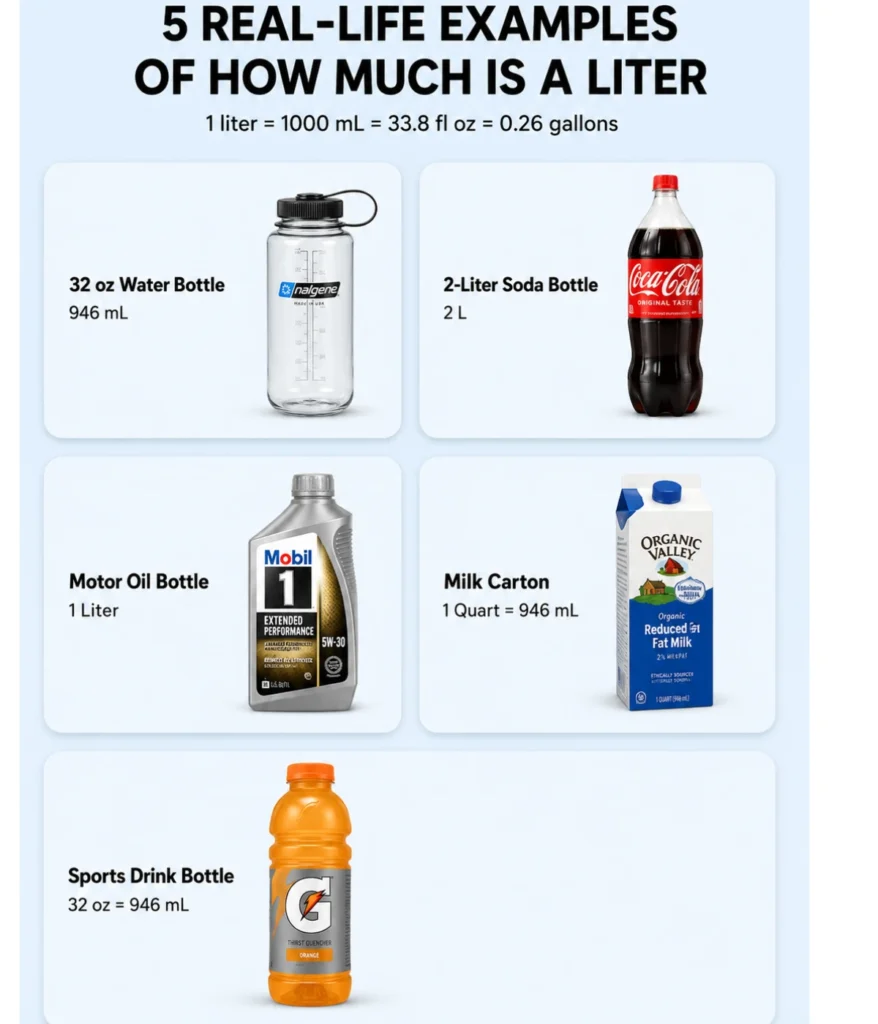
The number “1,000 mL” sounds clinical. These five physical examples make how much is a liter impossible to forget.
Standard Water Bottle (Nalgene 32 oz)
A Nalgene Wide Mouth 32 oz bottle holds 946 mL — just 54 mL (about 11 teaspoons) short of a full liter. Most Americans hydrating with a single Nalgene are just barely under their liter mark.
To reach 2–3 liters daily (the general adult hydration target), you need two full Nalgene fills plus a small glass of water. Medical professionals use 1-liter sterile saline bags as the baseline IV rehydration unit in U.S. emergency departments.
2-Liter Soda Bottle (Coca-Cola)
A Coca-Cola 2L bottle is the most universally recognized liter reference in American households. It stands roughly 13 inches tall — taller than a standard school ruler — and holds exactly 67.6 fl oz of liquid.
From a public health lens, 2 liters of regular Coca-Cola contains approximately 216 grams of added sugar, nearly 9 times the WHO’s recommended daily sugar limit of 25 grams. That context makes the liter a public health unit, not just a measurement one.
Motor Oil Bottle (Mobil 1 Full Synthetic)
Mobil 1 Full Synthetic motor oil is sold in 1-liter bottles at virtually every U.S. auto parts retailer. A standard passenger car engine requires 4–5 liters of oil for a complete oil change — equivalent to 4–5 standard water bottles.
Automotive engineers measure engine displacement (e.g., a “5.0L V8”), fuel consumption, and coolant capacity entirely in liters. The liter is the native language of the transportation industry.
1-Quart Milk Carton (Organic Valley)
A standard 1-quart (946 mL) milk carton sits within 54 mL of a full liter — making it the closest everyday kitchen item to the exact liter mark. One liter of whole milk delivers approximately 610 calories, 32 grams of protein, and 1,200 mg of calcium per the USDA FoodData Central database.
The adult human stomach, when comfortably full, holds roughly 1 liter of volume — which is why finishing a full quart of milk in one sitting feels physically challenging.
Sports Drink Bottle (Gatorade 32 oz)
A Gatorade Thirst Quencher 32 oz bottle holds 946 mL — close enough that athletes and coaches treat it as a liter-equivalent for hydration planning. Per the ACSM, athletes should replace 1 liter of electrolyte fluid per hour during sustained activity in warm conditions.
One liter of Gatorade Thirst Quencher delivers approximately 270 mg of sodium — about 10% of the average adult’s daily sodium intake per American Heart Association (AHA) guidelines. These numbers turn how much is a liter from a math question into a genuine performance and health calculation.
FAQ’s About How Much Is a Liter
How many gallons in a liter ?
1 liter = 0.264172 U.S. gallons. You need just under 4 liters to fill one full U.S. gallon.
How many ounces in a liter ?
1 liter = 33.814 U.S. fluid ounces. This is based on the NIST official measurement standard for the U.S. fluid ounce.
How many oz in a liter ?
1 liter = 33.8 fl oz. Round to 34 oz for quick cooking and hydration calculations.
How many cups in a liter ?
1 liter = 4.23 U.S. cups — just a fraction more than 4 full 8-oz measuring cups.
How many milliliters are in a liter ?
Exactly 1,000 milliliters. This is a fixed BIPM metric conversion that never changes.
How many quarts in a liter ?
1 liter = 1.057 U.S. liquid quarts. A liter is just slightly larger than one standard quart (946 mL).
How many ounces are in a liter ?
33.814 U.S. fluid ounces. This is the standard used in daily hydration tracking and clinical fluid therapy.
Conclusion
How much is a liter comes down to one anchor number — 1,000 mL — and everything else flows from it. Whether you’re converting to gallons (0.264), fluid ounces (33.814), cups (4.23), or quarts (1.057), you now have the exact formulas, quick shortcuts, and real-world anchors to work with it instantly.
The liter is the world’s most practical liquid volume unit — used in kitchens, hospitals, gas stations, and gyms across the globe. Bookmark this guide and every liter conversion you’ll ever need is right here in one place.

Fitness guru and lead author, crafting every post with passion. Certified trainer dedicated to your online fitness journey—empowering steps toward a healthier you!