This guide covers everything — the exact volume, the visual size, how it converts, and the mistakes most home cooks never realize they’re making.
How Much Is a Teaspoon, Exactly?
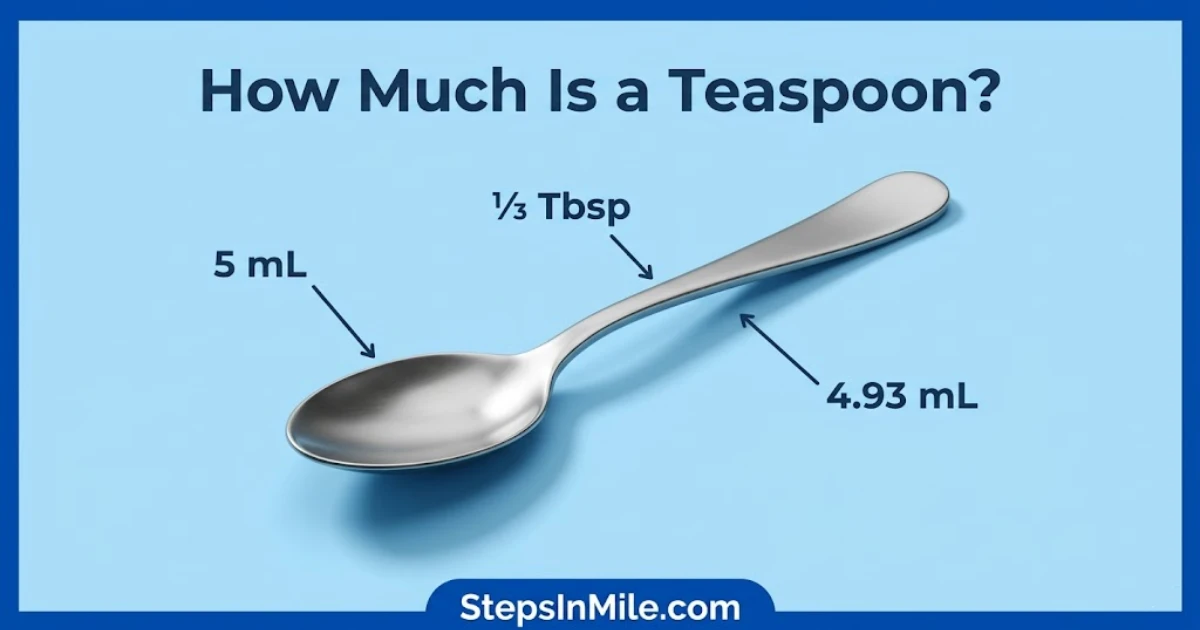
What matters most is this: 1 teaspoon = 5 mL, full stop.
A teaspoon is one of the most used unit of measurement in American cooking and baking — yet it’s one of the most misunderstood.
In the United States, the standard measuring teaspoon holds 5 mL of volume. This is the value recognized by the U.S. Food and Drug Administration (FDA) for nutrition labeling and by the metric system for cooking purposes.
The slightly different US customary teaspoon — used in older American recipes — measures 4.92892 mL. The difference is less than a tenth of a milliliter, so for everyday cooking and baking, they’re treated as identical.
What Does a Standard US Teaspoon Measure?
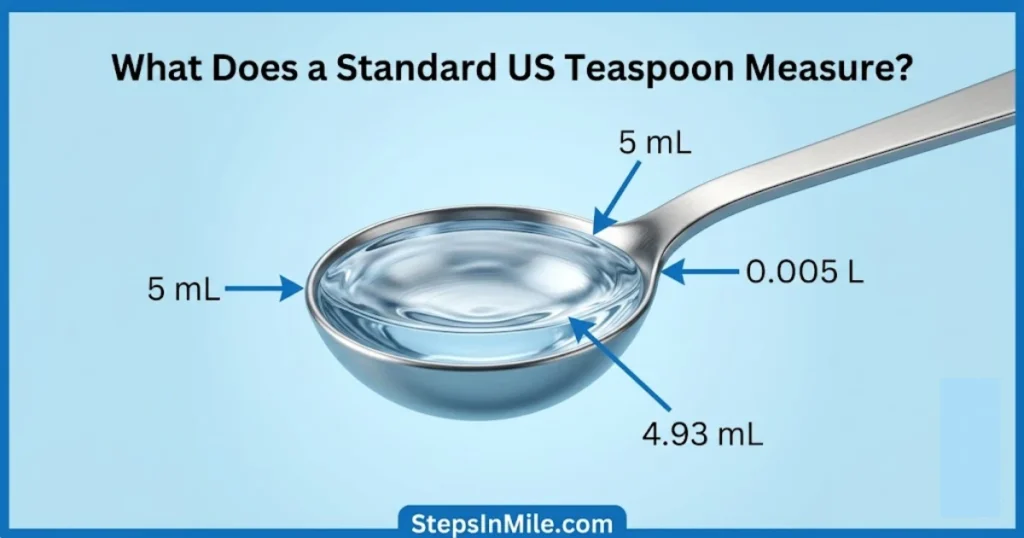
Here’s the exact breakdown of one US teaspoon across different measurement systems:
- Volume (metric): 5 mL
- Volume (US customary): 4.92892 mL
- Volume (imperial): 0.1734 fl oz
- Fraction of a tablespoon: 1/3 tablespoon
- Fraction of a cup: 1/48 cup
The International System of Units (SI) uses the liter as its base volume unit. One teaspoon equals 0.005 liters — tiny but precise.
According to the FDA’s guidelines on nutrition labeling, a teaspoon is defined as 5 mL for all consumer-facing food products sold in the US. That makes it an official, legally recognized volume measurement in American commerce.
How Big Is a Teaspoon Compared to Everyday Objects?
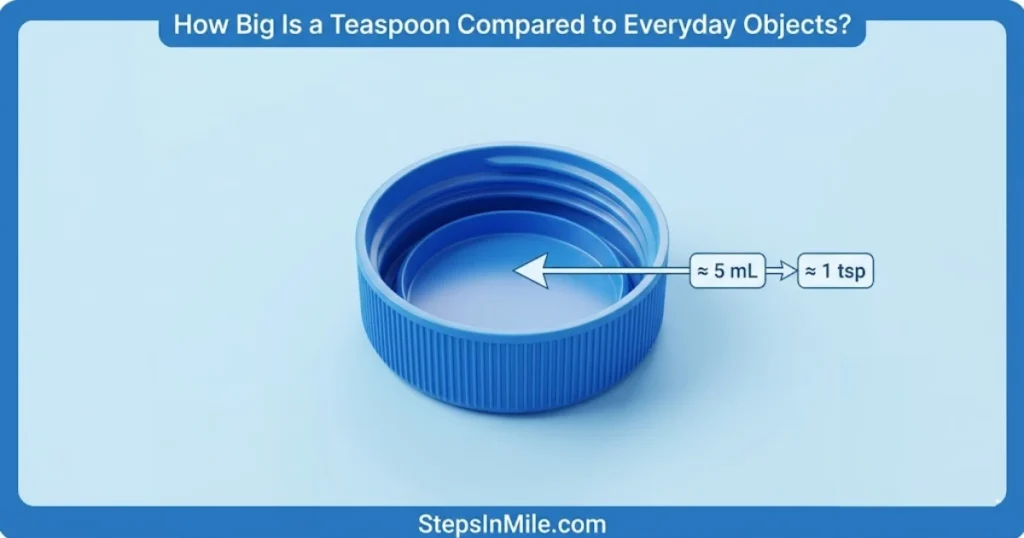
Numbers alone don’t always paint the picture. Here’s how big one teaspoon actually is in real-world terms:
- About the size of the tip of your thumb from knuckle to tip
- Roughly equal to one standard sugar cube dissolving in liquid
- Approximately the size of a bottle cap from a standard water bottle
- Close to one full dropper of liquid medicine
That’s a small but mighty measurement. One teaspoon of table salt, for example, contains around 2,300 mg of sodium — the entire recommended daily intake for most adults, according to the American Heart Association.
This is why getting a teaspoon measurement right isn’t just about taste — it’s about nutrition, safety, and precision.
Teaspoon Conversions, Formula & Shortcut Table
Understanding how a teaspoon connects to other units of measurement saves you time in the kitchen and prevents costly recipe mistakes.
How Many Teaspoons in a Tablespoon?
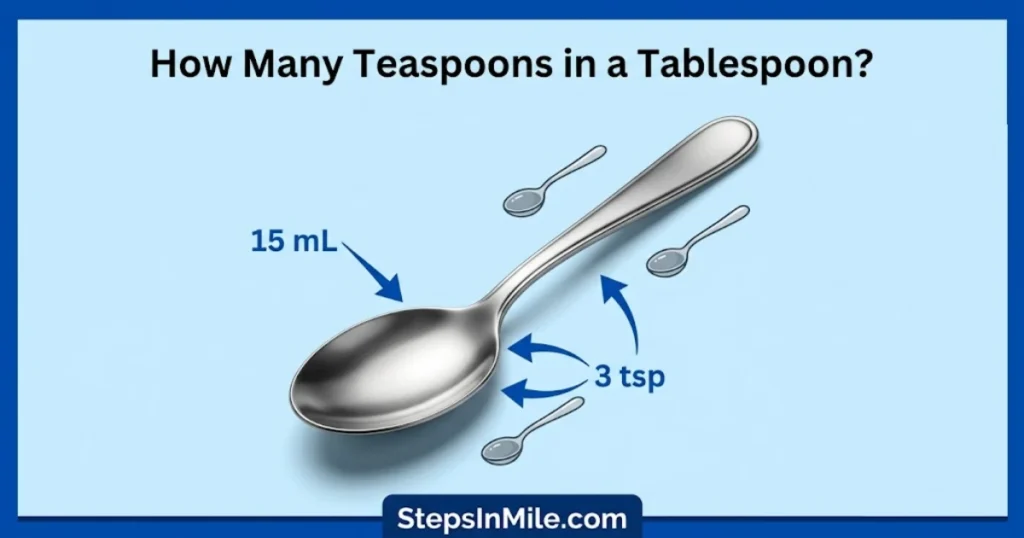
This is the most asked teaspoon conversion question in American cooking — and the answer is clean and simple.
3 teaspoons = 1 US tablespoon
Formula:
Number of tablespoons × 3 = Number of teaspoons
Shortcut:
Think of it this way — T is for Three. One Tablespoon (T) holds exactly three teaspoons (t).
Worked Example:
You need 2 tablespoons of olive oil. How many teaspoons is that? 2 × 3 = 6 teaspoons
Here’s a quick teaspoon to tablespoon conversion reference:
- ¼ tablespoon = ¾ teaspoon
- ½ tablespoon = 1½ teaspoons
- 1 tablespoon = 3 teaspoons
- 2 tablespoons = 6 teaspoons
- 4 tablespoons = 12 teaspoons
Important regional note: In Australia, one tablespoon equals 4 teaspoons (20 mL) — not 3. If you’re following an Australian recipe, that difference can quietly throw off your entire dish. Most US recipe blogs skip this entirely, so keep it in mind.
How Many Milliliters in a Teaspoon? (US vs. Metric)
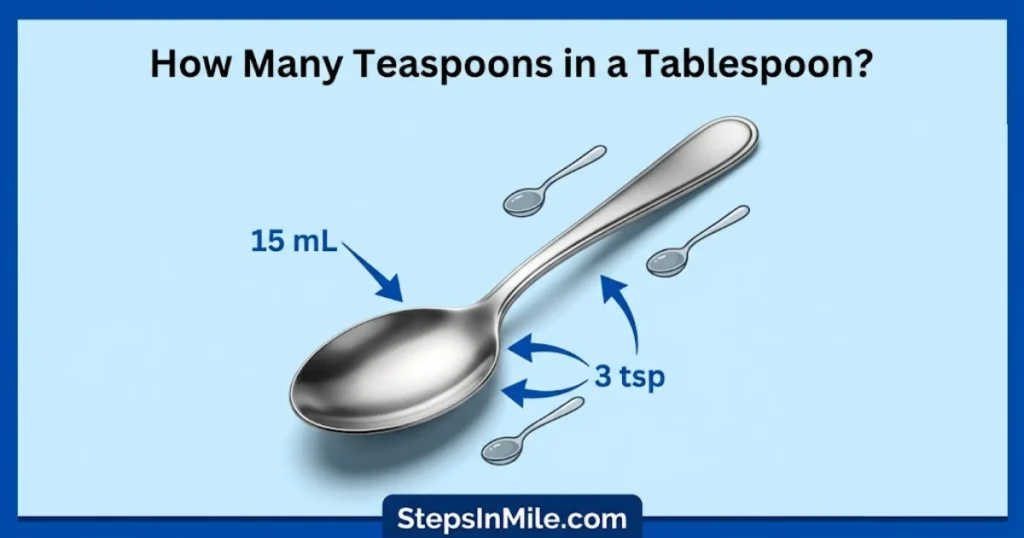
This conversion bridges American cooking with the metric system — and it’s especially critical for liquid medication dosing, pharmaceutical measurements, and international recipes.
Formula:
Number of teaspoons × 5 = Number of milliliters
Shortcut:
1 tsp = 5 mL — always. This is the number to lock in memory.
Worked Example:
A children’s fever reducer calls for 10 mL. How many teaspoons is that? 10 ÷ 5 = 2 teaspoons
Here’s a clean teaspoon to milliliter reference:
- 1 tsp = 5 mL
- 2 tsp = 10 mL
- 3 tsp = 15 mL
- 4 tsp = 20 mL
- 6 tsp = 30 mL
The US customary teaspoon measures 4.92892 mL — but the FDA, the National Institutes of Health (NIH), and most US pharmacies round this to 5 mL for practical dosing. When measuring liquid medicine or supplements, always treat 1 tsp as 5 mL.
How Big Is a Teaspoon in Real-Life Kitchen Situations?
Reading numbers on a page is one thing. Knowing what a teaspoon does with real ingredients — that’s what makes you a better cook.
Teaspoon of Salt vs. Sugar vs. Flour
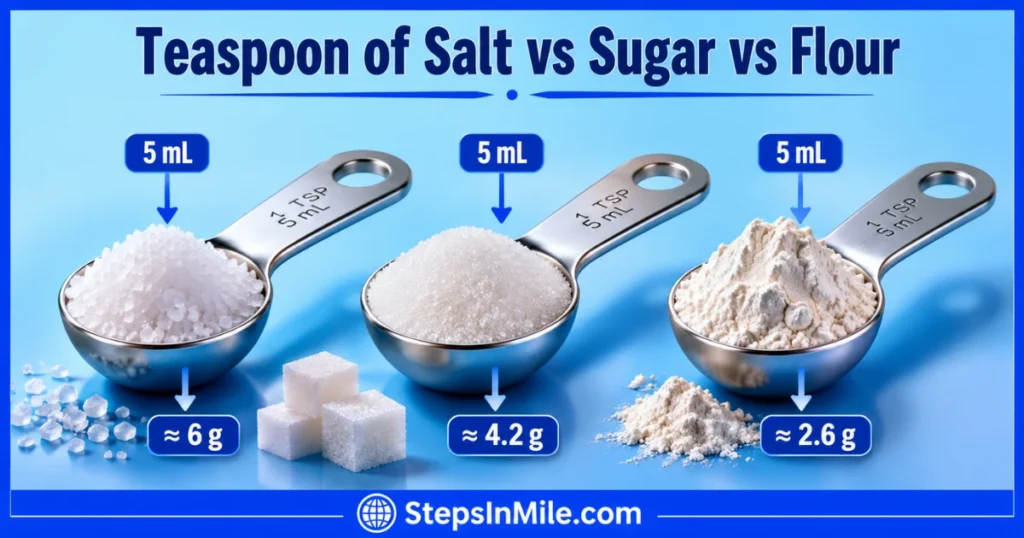
Here’s a fact that surprises most home cooks: one teaspoon always holds the same volume, but the weight changes completely depending on the ingredient.
This happens because of ingredient density — how tightly molecules pack together in a given space.
One teaspoon of common ingredients by gram weight:
- Table salt: ~6 grams
- Granulated sugar: ~4.2 grams
- All-purpose flour: ~2.6 grams
- Baking powder: ~4 grams
- Honey: ~7 grams
- Ground cinnamon: ~2.6 grams
- Vanilla extract: ~4.2 grams
- Butter (softened): ~4.7 grams
- Cocoa powder: ~2.5 grams
Think of it this way: a teaspoon of honey and a teaspoon of flour fill the same spoon — but honey is nearly three times heavier. That’s the difference between volume measurement and weight measurement.
For baking, where chemical reactions depend on precise ratios, this distinction matters enormously. Baking soda, cream of tartar, and yeast are especially sensitive. Even half a teaspoon too much can change the texture, rise, and flavor of your final product.
For cooking — soups, stir-fries, marinades — you have more flexibility. But in baking, always measure by volume using a proper measuring spoon, not by estimate.
Level, Rounded, and Heaped Teaspoon
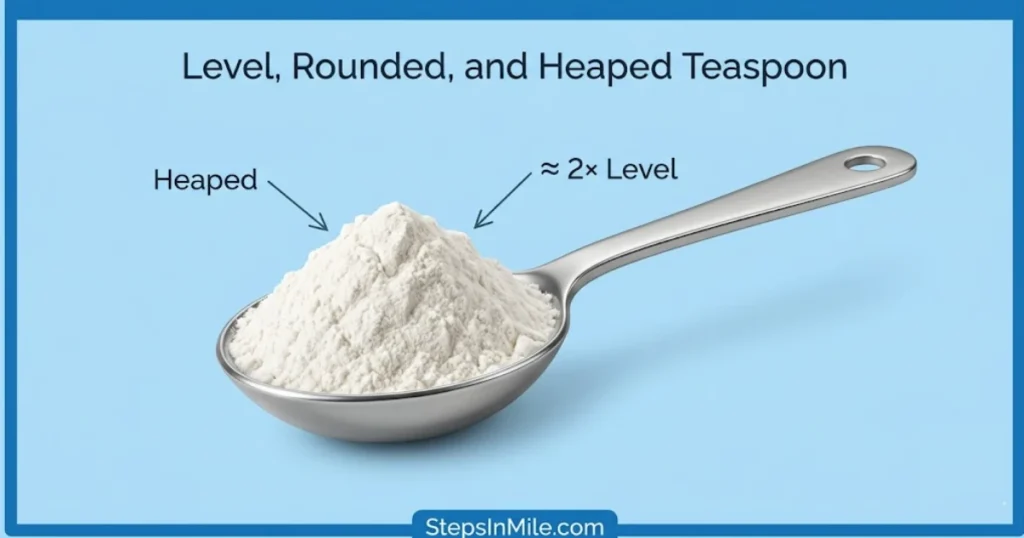
Most American recipes assume a level teaspoon — but three types exist, and they are not interchangeable.
Level teaspoon: The ingredient is scooped and then swept flat with a straight edge (like the back of a knife). This is the standard US recipe measurement. All the conversion values in this article assume a level teaspoon.
Rounded teaspoon: The ingredient sits naturally above the rim of the spoon in a gentle dome. A rounded teaspoon holds roughly 1.5× the volume of a level teaspoon. Some older recipes use this — usually specified explicitly.
Heaped teaspoon: The maximum amount that fits without spilling — a generous mound. A heaped teaspoon can hold nearly double a level teaspoon in volume.
When a recipe says “1 teaspoon of baking powder” without any qualifier, it always means level. Using a heaped teaspoon of baking soda by accident is one of the most common — and most disruptive — baking errors in the home kitchen.
The Teaspoon Mistake Most Home Cooks Make (And How to Fix It)
This is the section most cooking blogs gloss over — and it’s the one that actually makes a difference in your recipes.
Flatware Spoon vs. Measuring Spoon
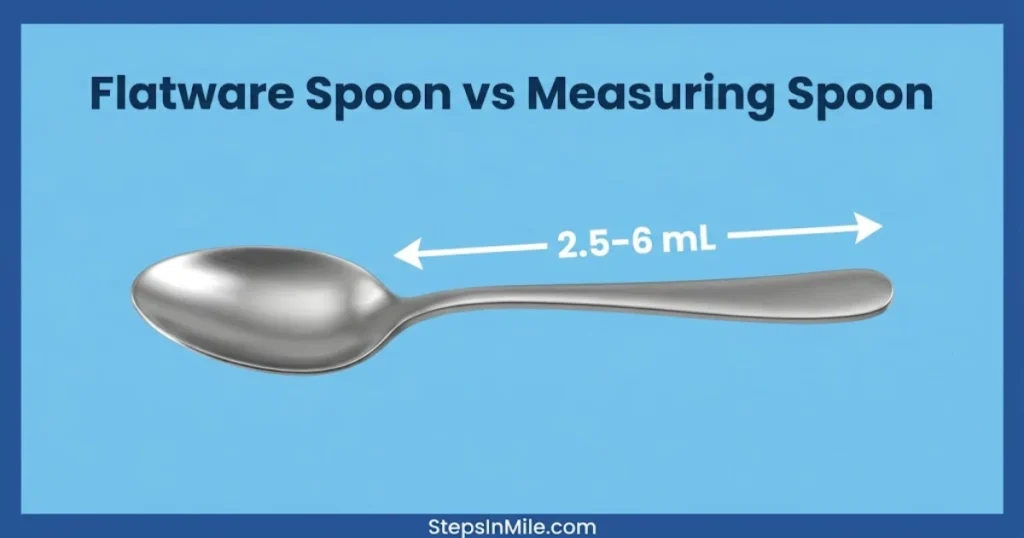
The spoon in your silverware drawer is not a measuring spoon. This sounds obvious — but in practice, millions of home cooks use their everyday dinner teaspoon as a substitute. It’s a mistake that silently ruins recipes.
A standard flatware teaspoon — the kind that comes in a cutlery set — can hold anywhere from 2.5 mL to 6 mL depending on its brand, shape, and style. That’s a potential error range of nearly 100% compared to the standard 5 mL.
Here’s what that means in practice:
- Too little salt → bland, flat-tasting food
- Too much baking soda → a metallic, soapy taste and poor texture
- Wrong dose of liquid medication → a real safety concern, especially for children
A calibrated measuring spoon — the kind sold in sets at any kitchen supply store — is standardized to exact volumes. The National Institute of Standards and Technology (NIST) maintains the official definitions for US measurement units, and proper measuring spoons are manufactured to match those definitions.
The fix is simple: use a proper measuring spoon, always.
FAQ’s About Teaspoon Measurements
How Many Teaspoons in a Tablespoon?
3 teaspoons = 1 US tablespoon. This is the standard for all American recipes. Note: in Australia, 1 tablespoon = 4 teaspoons (20 mL).
How Many Milliliters in a Teaspoon?
1 teaspoon = 5 mL by the metric standard used in the US. The precise US customary value is 4.92892 mL, but 5 mL is used universally for cooking and medicine.
How Much Is a Teaspoon?
1 US teaspoon = 5 mL = ⅓ tablespoon = 1/48 cup. The weight varies by ingredient — 1 tsp of salt weighs about 6g, while 1 tsp of flour weighs about 2.6g.
How Big Is a Teaspoon?
A standard measuring teaspoon is roughly the size of your fingertip or a sugar cube — a small, shallow bowl holding exactly 5 mL of volume.
Conclusion
One US teaspoon = 5 mL = ⅓ tablespoon — and that small number carries enormous weight in every recipe you make.
Whether you’re measuring baking powder for a birthday cake, dosing liquid medicine for your child, or converting a recipe from grams to teaspoons — now you have the exact numbers, the right context, and the practical tools to get it right every time.

Fitness guru and lead author, crafting every post with passion. Certified trainer dedicated to your online fitness journey—empowering steps toward a healthier you!