Choosing the right propane tank size starts with understanding exact dimensions. Whether you’re installing a residential propane tank or transporting a portable cylinder, knowing the measurements ensures safe placement, proper clearances, and efficient propane delivery.
This guide covers propane tank dimensions from 20-pound grills tanks to 2,000-gallon commercial systems.
Propane Tank Capacity, Size, and Weight Specifications
The 80% Fill Rule and Tank Capacity
Tanks are filled to only 80% capacity, leaving 20% vapor space for safe thermal expansion.
500 gal tank: 400 gal usable • 100 gal buffer
1,000 gal tank: 800 gal usable
Reading Propane Tank Specifications
Water capacity = total volume if filled with water
Propane capacity = usable fuel at 80% fill
Empty vs. Full Weight (500 gal Tank)
Propane weighs 4.2 lbs per gallon
Empty (tare): ~1,000 lbs
Propane (400 gal): 1,680 lbs
Full total: ~2,680 lbs
Residential Propane Tank Sizes
Small Portable Tanks
(20 lb – 100 lb)
20 lb tank
18″ tall × 12″ Ø
4.7 gal • Empty: 17 lb • Full: 37 lb
Grills, camping, patio heaters
100 lb tank
~48″ tall × 12″ Ø
23.6 gal usable
Empty: 67–70 lb • Full: ~170 lb
Food trucks, generators
Medium Residential Tanks
(120 – 500 Gallons)
120 gal (vertical)
54.5″ tall × 30″ Ø
96 gal usable
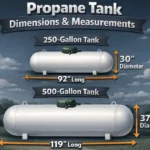
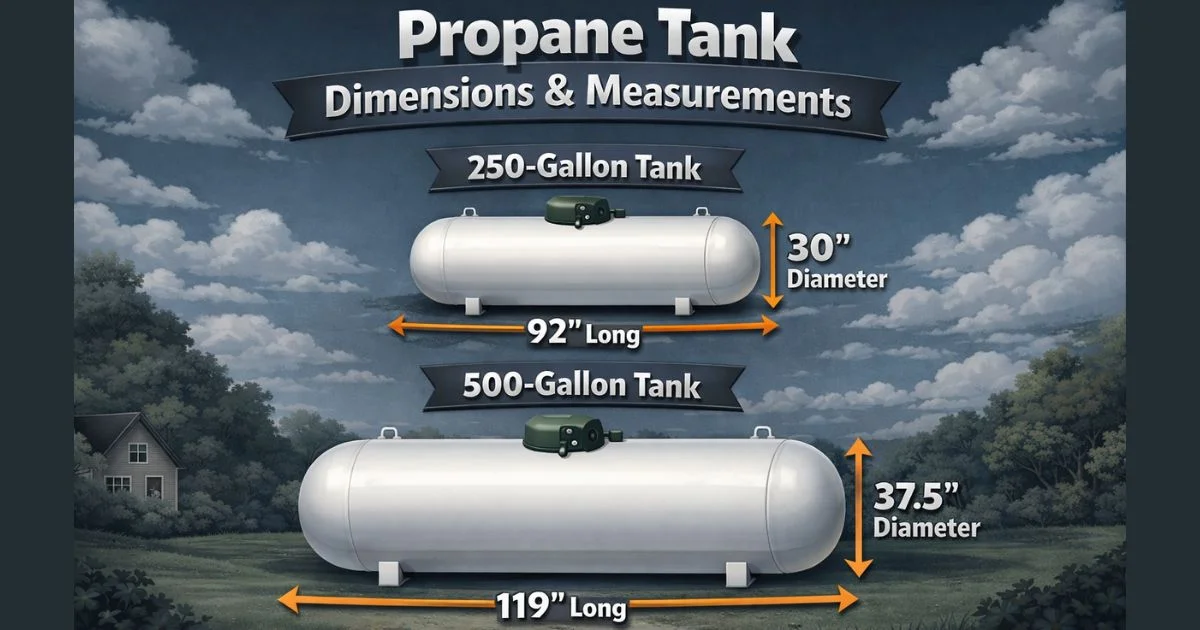
250 gal (horizontal)
92″ long × 30″ Ø
Empty: 483 lb • Full: 1,333 lb
500 gal (horizontal)
119″ long × 37.5″ Ø
Empty: 1,000 lb • Full: 2,680 lb
Large Residential & Commercial
(1,000 – 2,000 Gallons)
1,000 gal
~16 ft long × 41″ Ø (above-ground)
Empty: >1,750 lb • Full: ~5,110 lb
2,000 gal
~20 ft long × 48″ Ø (above-ground)
Often buried for aesthetics & zoning
Large homes, farms, commercial use
Propane Tank Installation Requirements
Legal Clearance Requirements by Tank Size
NFPA 58 code mandates 10-foot minimum distance between 125-500 gallon tanks and buildings, property lines, or sources of ignition. Tanks exceeding 500 gallons require 25-foot clearances from structures.
Portable cylinders under 125 gallons need 5-foot spacing from building openings and 10 feet from any ignition source. These rules protect against gas accumulation near doors, windows, and air intakes.
Foundation and Ground Preparation
500-gallon and larger tanks require concrete pad foundations minimum 4 inches thick, extending 12 inches beyond tank dimensions on all sides. Reinforced concrete withstands loaded weight without cracking or settling.
Smaller tanks under 250 gallons can use compacted gravel bases 6 inches deep. Level the area perfectly—even slight slopes cause stress on tank mountings and connection fittings.
Access Requirements for Delivery and Service
Propane delivery trucks need 12-foot clearance width and adequate turning radius to reach your tank. Measure driveway width, gate openings, and approach angles before installation.
Tank gauges and fill connections must remain accessible year-round. Plan for snow clearance in winter climates. Avoid planting shrubs or installing fencing that blocks service access—suppliers may refuse delivery if they can’t safely approach.
Question’s
What are the dimensions of a propane tank?
Common residential propane tank dimensions vary by capacity. A 250-gallon tank measures 92 inches long and 30 inches in diameter. A 500-gallon tank spans 119 inches long with 37.5-inch diameter.
How tall is a 1000 gallon propane tank?
1,000-gallon above-ground tanks measure 16 feet in length and 41 inches in diameter when installed horizontally.
How big is a 2000 gallon propane tank?
2,000-gallon propane tanks reach approximately 20 feet long with 48-inch diameter for horizontal above-ground installation.
What is the 80 20 rule for propane tanks?
The 80/20 propane rule limits filling to 80% of total tank capacity, leaving 20% expansion space.
Why are propane tanks only filled to 80%?
Propane expands 17 times more than water when heated. Filling beyond 80% eliminates expansion room, causing excessive pressure that can trigger relief valves or tank rupture.
The 20% vapor space accommodates temperature swings from winter cold to summer heat, maintaining safe operating pressure under all conditions.
Is it okay to leave a propane tank outside in summer?
Yes, propane tanks safely remain outdoors year-round when properly installed.
What is a common size for a residential propane tank?
250-gallon and 500-gallon tanks dominate residential installations. The 250-gallon size (92 inches long) suits homes using propane for 2-3 appliances.
What is the difference between Type 1 and Type 2 propane tanks?
Type 1 propane tanks include OPD (Overfill Protection Device) valves with triangular hand wheels, required since 1998.
Can I transport a tank in my car?
Yes, transport portable propane cylinders in vehicles following safety rules. Keep tanks upright and secured to prevent tipping.
Conclusion
Propane tank dimensions directly impact installation costs, placement options, and long-term convenience. Measure your available space, calculate annual propane consumption, and verify local clearance requirements before selecting tank size.
Choose 500-gallon residential tanks for whole-house systems or 250-gallon tanks for supplemental heating. Always follow NFPA 58 guidelines and work with certified installers for tanks exceeding 100 pounds capacity.

Fitness guru and lead author, crafting every post with passion. Certified trainer dedicated to your online fitness journey—empowering steps toward a healthier you!