Building or understanding a tennis court starts with knowing the exact measurements. Whether you’re a player, homeowner, or facility manager, getting the court dimensions right ensures proper gameplay and meets official standards.
This guide breaks down every measurement you need. From standard court sizes to spacing requirements, you’ll find precise specifications used worldwide.
Standard Tennis Court Dimensions and Size

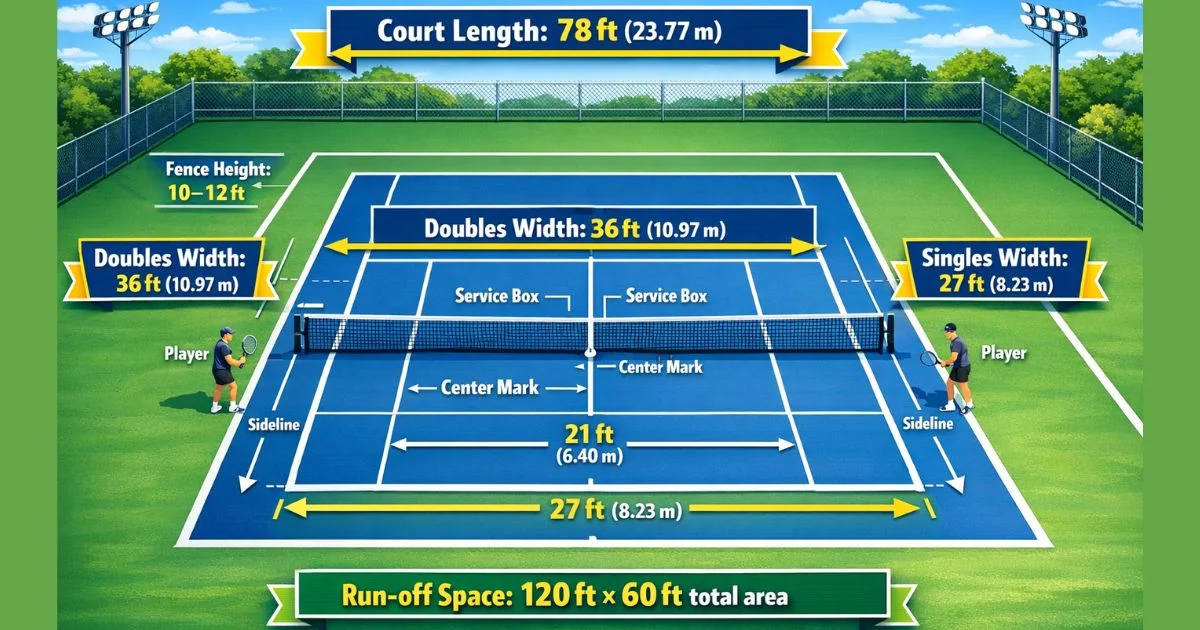
A regulation tennis court measures exactly 78 feet long and 36 feet wide for doubles play. This standard applies globally and follows strict International Tennis Federation (ITF) guidelines established for professional and recreational use.
For singles matches, the court length stays at 78 feet, but the width reduces to 27 feet. The sidelines move inward by 4.5 feet on each side, creating a narrower playing area that changes the game’s dynamics.
In metric measurements, a doubles court spans 23.77 meters by 10.97 meters. A singles court maintains the 23.77-meter length but narrows to 8.23 meters wide, making conversions straightforward for international projects.
The total playing surface area covers 2,808 square feet (260.87 square meters) for doubles courts. Singles courts occupy 2,106 square feet (195.65 square meters), which matters when calculating materials, lighting, and construction costs.
Space Requirements for Building a Tennis Court

The minimum recommended space is 120 feet long by 60 feet wide for a complete tennis court installation. This includes mandatory clearance zones that prevent injuries when players chase down shots near boundaries.
Side clearance should measure at least 12 feet on each side, though 15-21 feet is ideal for competitive play. End clearance requires 18-21 feet beyond both baselines, giving players room to follow through on powerful groundstrokes.
For residential tennis courts, most homeowners need a property section at least 7,200 square feet (roughly 120 x 60 feet). This accounts for the court itself plus safety zones, fencing, and minimal landscaping buffers.
Vertical clearance matters too, especially for indoor facilities. The ITF recommends a minimum height of 20 feet above the court surface, increasing to 30-40 feet for professional venues where high lobs are common.
Club and tournament facilities often expand these measurements further. Championship courts may allocate 130-140 feet in length and 65-70 feet in width, accommodating spectator areas, chair umpire stands, and enhanced player amenities.
Tennis Court Line Markings and Layout

The baseline runs along each 36-foot end of the court and must be exactly 4 inches wide. This is where players serve from and where most rallies begin, making it the most heavily trafficked line on the court.
A service line sits 21 feet from the net on both sides, running parallel to the baseline. Between these lines, the court divides into service boxes where serves must land to be considered legal.
The center service line splits the court down the middle, perpendicular to the net. It’s 4 feet long and creates two equal service boxes measuring 21 feet deep by 13.5 feet wide on each side.
Net height specifications are critical for fair play. The net measures 3 feet (0.914 meters) at the center and 3.5 feet (1.07 meters) at the posts, creating a slight downward slope toward the middle.
Singles sidelines run 4.5 feet inside the doubles sidelines on each side. These inner lines define the court boundaries for one-on-one matches while keeping the same baseline positions.
All court lines should be between 2 and 3 inches wide according to official standards. White is the universal color for maximum visibility, though some clay courts use contrasting tape or paint that shows up against the red surface.
The center mark is a small 4-inch line at the midpoint of each baseline. It helps servers position themselves correctly and ensures they alternate sides between points during matches.
Types of Tennis Court Surfaces and Their Dimensions

Hard courts maintain the exact standard dimensions regardless of the acrylic or asphalt base. These surfaces dominate American tennis, accounting for roughly 70% of courts nationwide due to their durability and low maintenance needs.
Clay courts use the same measurements but the surface material affects play speed dramatically. Red clay is most common in Europe, while green clay (Har-Tru) is popular in the eastern United States for its softer, joint-friendly characteristics.
Grass courts follow identical dimensional standards but require the most intensive upkeep. Wimbledon’s legendary grass plays fast and low, though less than 5% of courts worldwide use natural grass due to climate limitations and maintenance costs.
Carpet courts and indoor surfaces stick to regulation sizes while offering consistent bounce year-round. These synthetic surfaces appear primarily in colder climates where outdoor play becomes impossible during winter months.
Cushioned acrylic surfaces add a layer of rubber beneath the top coating. This modification doesn’t change dimensions but reduces impact by up to 30%, making it easier on knees and ankles during extended matches.
Multi-surface facilities sometimes feature courts with identical measurements but different playing characteristics. This variety helps players develop well-rounded games by adapting to various speeds and bounces.
Tennis Court Fence Height and Perimeter

Standard fence height ranges from 10 to 12 feet around the entire court perimeter. This prevents balls from leaving the playing area while maintaining clear sightlines for spectators and players waiting their turn.
Most municipal and club courts install 10-foot chain-link fencing as the baseline standard. Higher fences (12-14 feet) work better for windy locations or facilities near roads where stray balls create safety hazards.
Fence placement should sit at least 12 feet from the sidelines and 21 feet from the baselines. This clearance zone ensures players don’t collide with fencing during aggressive play while keeping the enclosure effective.
Wind screens attach to fencing and typically add 1-2 inches of thickness. These mesh materials reduce wind interference by up to 70% and provide privacy without requiring taller fence structures or additional posts.
Gates and access points need minimum widths of 4 feet for maintenance equipment. Professional facilities often include 6-8 foot openings to accommodate grooming machines, court sweepers, and resurfacing equipment during annual maintenance.
Building codes in most US jurisdictions require tennis court fencing to withstand wind loads of 70-90 mph. Galvanized steel posts set in concrete every 10 feet provide the structural integrity needed for long-term stability.
Lighting poles for night play typically stand 20-30 feet tall, positioned outside the fence line. These fixtures must clear the fence by several feet and aim downward to minimize light pollution for neighboring properties.
More Post: How Many Steps Would I Need to Take Everyday to Lose Weight.
FAQ’s About Tennis Court Dimensions & Measurements
What is the size of a standard tennis court?
A standard tennis court size is 78 feet long by 36 feet wide for doubles. Singles courts measure 78 feet by 27 feet, maintaining the same length but reducing width by 9 feet total.
How much space do you need for a tennis court?
You need a minimum total area of 120 feet by 60 feet (7,200 square feet) for a complete court. This includes the playing surface plus mandatory run-off zones of 12-21 feet on all sides for safe play.
What is the international standard for a tennis court?
The ITF standard specifies 23.77 meters by 10.97 meters for doubles courts. These measurements apply worldwide for all official competitions, from local tournaments to Grand Slam championships.
How many sqm is a tennis court?
A tennis court area covers approximately 260.87 square meters (2,808 square feet) for doubles play. Singles courts occupy 195.65 square meters, with the reduced width accounting for the size difference.
What are the four types of tennis courts?
The four main court surfaces are hard court, clay court, grass court, and carpet/indoor court. Each surface plays differently but maintains identical dimensions of 78 by 36 feet for standard doubles matches.
How big is a small tennis court?
A mini tennis court for youth players measures 36 feet by 18 feet. Some recreational facilities build half courts at 39 by 18 feet, perfect for practice drills or limited spaces.
What is the best surface for a tennis court?
Hard court surfaces work best for most players due to consistent bounce, weather resistance, and low maintenance. Clay courts reduce joint impact, while grass offers the fastest play for serve-and-volley styles.
What size is a spec tennis court?
Platform tennis courts (often called paddle tennis) measure 44 feet by 20 feet. These smaller courts include surrounding deck space and 12-foot-high wire fencing for the signature bank shots.
How tall is a tennis fence?
Tennis court fencing typically stands 10-12 feet high around the perimeter. Wind screens may add 6-12 inches of visual height, while safety regulations sometimes require 14-foot fences near busy roads.
Conclusion
Tennis court dimensions follow precise standards that ensure fair play worldwide. The regulation 78 by 36-foot size accommodates both recreational and professional matches when combined with proper clearance zones.
These measurements and specifications helps you plan construction projects, evaluate existing facilities, or simply appreciate the game’s technical requirements. Whether you’re building a backyard court or managing a tennis center, accuracy in dimensions creates better playing experiences for everyone.

Fitness guru and lead author, crafting every post with passion. Certified trainer dedicated to your online fitness journey—empowering steps toward a healthier you!